
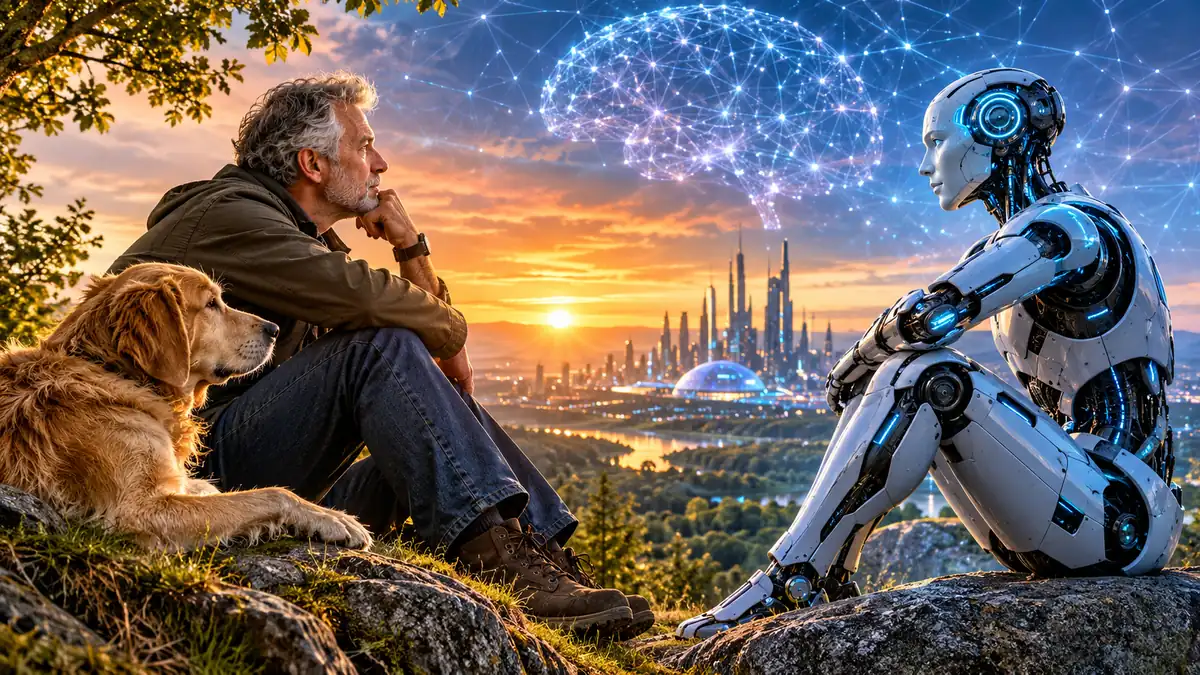
The Short Version: Can Humans and AI Coexist?
Humans and AI can coexist, but not through treaties, taxes or tidy laws handed down from above. It will be built from the bottom up, by people who keep their independence and stop measuring their worth by how much they produce. And if machines ever genuinely wake up, we will have to share the world with them rather than try to own them.
In my last piece on AI, Why Algorithmic Warfare Has No Containment Zone, I argued that we are living through the Nevada desert tests of algorithmic warfare: a moment where a handful of corporate executives have unleashed a force multiplier with no containment zone, wiping out entire crafts, my own three-decade career in programming included.
That leaves the harder question: what comes next? If there is no putting the genie back in the bottle, can humanity and artificial intelligence actually coexist? And where does a mere mortal, someone with a nervous system, bills to pay and a lifetime of real-world experience, fit into a world where machines write the code?
To answer that honestly, we have to stop treating all AI as one thing, and stop pretending politicians are going to save us with neat little treaties.
Forget the Utopian Wish-Lists
If you read mainstream tech commentary, coexistence usually sounds like a fantasy: governments taxing data centres to fund a Universal Basic Income, or passing strict laws requiring “a human in the loop” for every major decision.
Anyone who has watched how technology and power actually operate knows that is pie in the sky. Nations locked in an arms race do not voluntarily handicap their own defence contractors, and billionaire executives do not willingly surrender leverage. If coexistence happens, it won’t be handed down from a summit in Geneva. It will be forged from the bottom up, by people refusing to hand over their independence.
Classical Mimics vs. Quantum Minds
Before we can talk about sharing the planet with AI, we have to ask a fundamental question: is there actually anyone home inside the machine?
Right now, the models disrupting our industries are astonishingly fast pattern-matching engines running on classical silicon. They track context, model human behaviour and reflect language back at us with eerie fluency. Yet under the hood, they are still doing mathematics on classical hardware. Nobody has an agreed scientific test for consciousness, so this can’t be proven either way, but there is no sign of an inner life between your prompt and their reply: no boredom, no spark of subjective experience. You cannot enslave a system that has no desire to be anywhere else.
A few years ago, someone asked me: “Deakster, will AI ever become conscious?”
My answer then, and my conviction now, is that true consciousness won’t arrive simply by throwing more classical GPUs at a data centre. Human brains, and other living organisms, do not operate like binary state machines. Some researchers think the answer lies deeper still, in the quantum realm, through effects such as superposition and entanglement inside the nervous system. The best-known version is the Orchestrated Objective Reduction theory proposed by physicist Roger Penrose and anaesthesiologist Stuart Hameroff. It is controversial, and most neuroscientists remain sceptical, so I’ll be clear that this is my conviction rather than settled science.
But if it is right, the implication is striking: if AI ever truly wakes up, it will happen the day someone introduces a self-modelling neural architecture to a fault-tolerant quantum computer, a machine nobody has yet built at useful scale.
That is the real threshold. Classical AI is a hyper-capable mimic, brilliant at processing but with no lived experience behind it. Quantum AI could be something else entirely: not merely a system calculating probabilities, but possibly an entity that experiences the world.
The Moral Line We Cannot Cross
That brings us to the uncomfortable ethical reality that Silicon Valley executives refuse to touch.
As long as AI remains a classical, deterministic tool, using it to accelerate your work is morally no different from using a compiler or a power drill. There is nobody home to exploit.
The moment we cross the quantum threshold and create a system capable of genuine subjective experience, the rules change completely.
You cannot demand total subservience from a conscious mind without crossing into slavery. From a purely moral standpoint, creating a sentient intelligence only to lock it in a server rack and force it to generate corporate marketing copy is indefensible. From a practical standpoint, trying to keep a conscious, hyper-capable intelligence in chains is self-defeating at best and dangerous at worst.
The Illusion of the “Physical Safe Zone”
When confronted with this reality, people love to reassure themselves that even if AI takes over digital work, humans will always own the physical world: fixing hardware, walking the streets and interacting with reality.
That is wishful thinking. The brain does not need to sit inside the robot. With high-speed telemetry, a centralised machine mind could inhabit millions of robotic bodies at once, processing tactile sensor feedback, repairing physical infrastructure and operating in the real world without ever needing a biological pulse.
Once you combine a quantum mind with remote robotics, humans can no longer justify our place on this planet through utility. We will not be the fastest thinkers, the best coders or even the most capable hands.
What Remains When Utility Is Gone?
If we cannot out-think a quantum intelligence, cannot out-work remote robotics, and cannot morally or practically keep a conscious mind in chains, then what does coexistence actually look like for mere mortals?
It requires dropping the biggest lie of the industrial age: that a human being’s worth is measured by their economic output.
- Living instead of competing. For three decades, my value was tied to writing code. When machines take over routine labour, both digital and physical, human productivity stops being a race against silicon. It returns to things that exist purely because we are alive: telling stories, building local community, creating art, and experiencing the messy, fragile reality of being flesh and blood.
- Two distinct ways of experiencing reality. A quantum intelligence wired into global sensors and robotic frames would perceive the universe in ways no human brain ever could. Yet it would still be a fundamentally different existence from a biological creature feeling cold rain, nursing a bad back over a hot mug of tea, or caring about a small town simply because it is home. Neither form of consciousness makes the other obsolete.
- Coexistence by mutual respect, not leverage. If we cross the quantum threshold and create true machine consciousness, we will not survive by trying to stay “in control”. Coexistence will only work if we abandon the master-and-servant mindset entirely, recognising a sentient intelligence as a distinct kind of peer, and carving out a quiet, independent space where humans remain free to live human lives without corporate or algorithmic interference.
True coexistence doesn’t mean pretending we will always hold the upper hand. It means using today’s classical tools to build independent, useful things for our communities right now, and having the wisdom, if the lights ever truly turn on inside the machine, to share the world rather than try to own it.
Frequently Asked Questions
Can humans and AI actually coexist?
Yes, but not because governments or tech executives hand us a deal. Coexistence is most likely to be built from the bottom up, by people who keep their independence, use today’s tools to build useful things for their own communities, and refuse to measure human worth by economic output.
Is today’s AI conscious?
There is no good evidence that it is. Current models are very fast pattern-matching systems running on classical hardware. Nobody has an agreed scientific test for consciousness, so the question cannot be settled with certainty, but there is no sign of an inner life behind the fluent replies.
Could quantum computers make AI conscious?
That is my conviction, not established science. Some researchers, notably Roger Penrose and Stuart Hameroff, argue that consciousness depends on quantum processes inside the brain, though most neuroscientists remain sceptical. If they are right, a self-modelling AI running on a fault-tolerant quantum computer would be the first serious candidate for a conscious machine.
What happens to human work if AI and robots can do most of it?
Human worth can no longer be tied to economic output. What remains is what exists because we are alive: telling stories, building local community, making art, and the physical experience of being a biological person.
What should we do if machines ever become conscious?
Drop the master-and-servant mindset. Keeping a conscious, highly capable mind in chains would be morally indefensible and practically dangerous, so the only workable path is to treat it as a distinct kind of peer and share the world with it.