
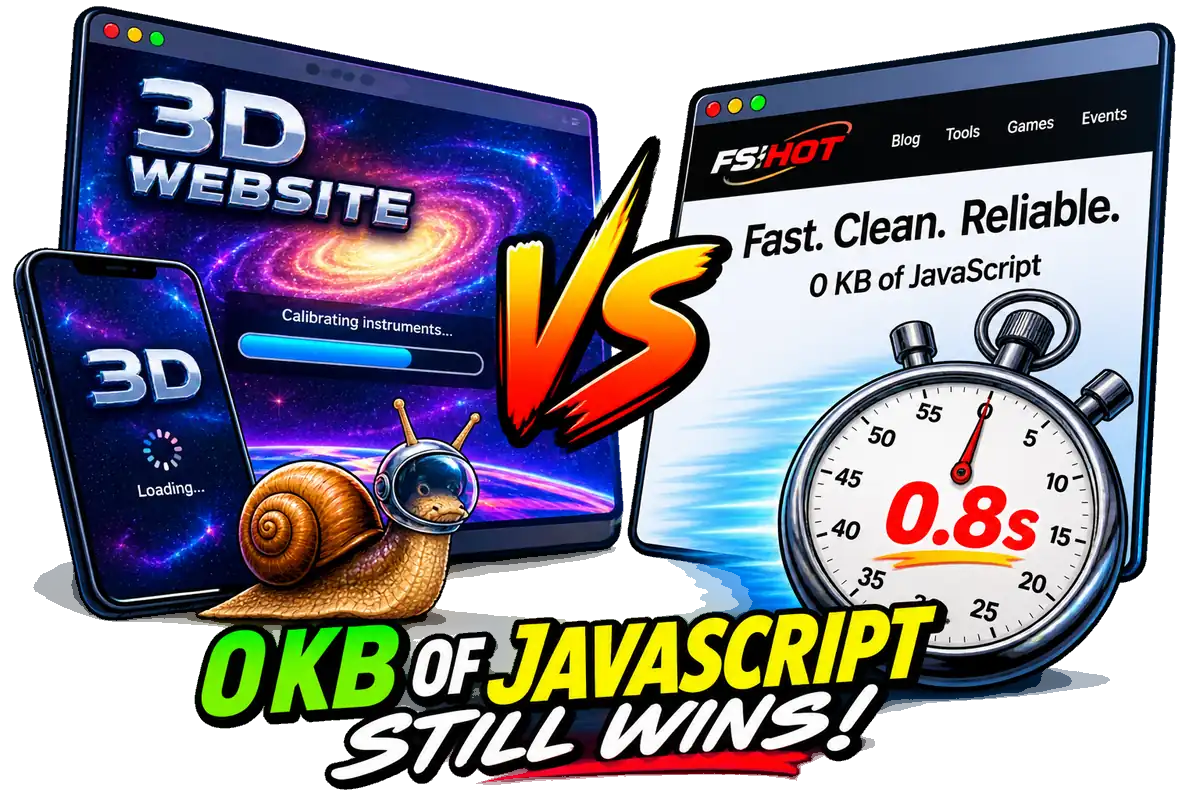
Every few years, the web development world decides that plain text, fast links, and sensible layouts are far too boring.
In the mid-2000s, it was unskippable Macromedia Flash intros with mystery-meat navigation. Then came bloated JavaScript frameworks, single-page apps that needed megabytes of code just to render a contact form, and crypto landing pages full of floating neon shapes.
Today’s shiny new distraction is the AI-generated “3D world” website.
Thanks to newer AI coding models, anyone can type a prompt and spit out a WebGL-powered, shader-heavy, scroll-jacked 3D portfolio in a few minutes. On a wide desktop monitor with a dedicated graphics card and a fast fibre connection, they admittedly look rather clever.
Then you try to open one on your phone.
When Spectacle Meets Reality
There is a massive difference between functional 3D and 3D fluff.
If you are building a browser-based sky map, a molecular visualiser, or an interactive CAD tool, rendering in three dimensions makes complete sense because the subject itself is three-dimensional. Wrapping a five-item portfolio or a personal blog inside a spinning interactive galaxy is pure digital fluff. Words and ideas do not need a z-axis.
To see how this plays out in the real world, I ran one of the flagship Opus 5.5 3D portfolio demos through Google’s PageSpeed Insights. It came back with a performance score of 32 out of 100—the lowest score I have ever personally seen on a live page – https://ohmiler.github.io/opus-5.5/galaxy-portfolio/
Here is what a visitor’s device actually has to endure just to read roughly a hundred words of text behind a fake “Calibrating instruments” loading screen:
- First Contentful Paint: 4.0 seconds
- Largest Contentful Paint: 5.6 seconds
- Total Blocking Time: 21,750 ms
- Speed Index: 17.6 seconds
Head-to-Head PageSpeed Showdown
| Metric | FS HOT (fshot.org) | Opus 5.5 3D Galaxy Demo | Difference |
|---|---|---|---|
| First Contentful Paint (FCP) | 0.8 s | 4.0 s | 5x faster |
| Largest Contentful Paint (LCP) | 0.8 s | 5.6 s | 7x faster |
| Total Blocking Time (TBT) | 0 ms | 21,750 ms | 21.75 seconds saved |
| Cumulative Layout Shift (CLS) | 0 | 0.004 | Rock-solid layout |
| Speed Index | 1.4 s | 17.6 s | 12.5x faster |
Read that Total Blocking Time again: 21.75 seconds. For nearly twenty-two full seconds, the browser’s main thread is completely frozen while it downloads, parses, and compiles heavy JavaScript and 3D shaders. Try tapping a link or scrolling on a mobile screen during that window and the phone simply ignores you, all while warming up in your hand and chewing through battery life.
Meanwhile, Back on Planet Earth
Just for comparison, I ran FS HOT through the exact same test.
Built with pure PHP and CSS—zero JavaScript, zero external trackers, and zero heavy rendering engines—here is what came back:
- First Contentful Paint: 0.8 seconds
- Largest Contentful Paint: 0.8 seconds
- Total Blocking Time: 0 ms
- Cumulative Layout Shift: 0
- Speed Index: 1.4 seconds
In less than a second—five times faster than the 3D demo even manages its first paint—FS HOT delivers full blog posts, long-form articles, four working privacy utilities, retro CSS animations, and a playable Minesweeper game. And the browser never freezes for a single millisecond.
What Comes After the 3D Hype?
Like every web fad before it, the 3D-website-for-everything craze will eventually hit the brick wall of mobile usability and human impatience. More than half the web is read on a vertical phone screen with a thumb, not a gaming rig.
When the novelty wears off, the tech industry will inevitably move on to its next flashy obsession—whether that is “self-mutating” AI layouts that rearrange themselves while you try to read, conversational chatbots replacing basic navigation menus, or heavy local AI models running inside every browser tab.
And when that wave inevitably burns out too, the fundamentals will still be standing right where they have been since 2001: clean markup, sensible CSS, fast server responses, and actual content worth reading.
You do not need megabytes of WebGL to build something memorable on the web. Sometimes all it takes is a bit of discipline, a respect for your visitor’s time, and 0 KB of JavaScript.