
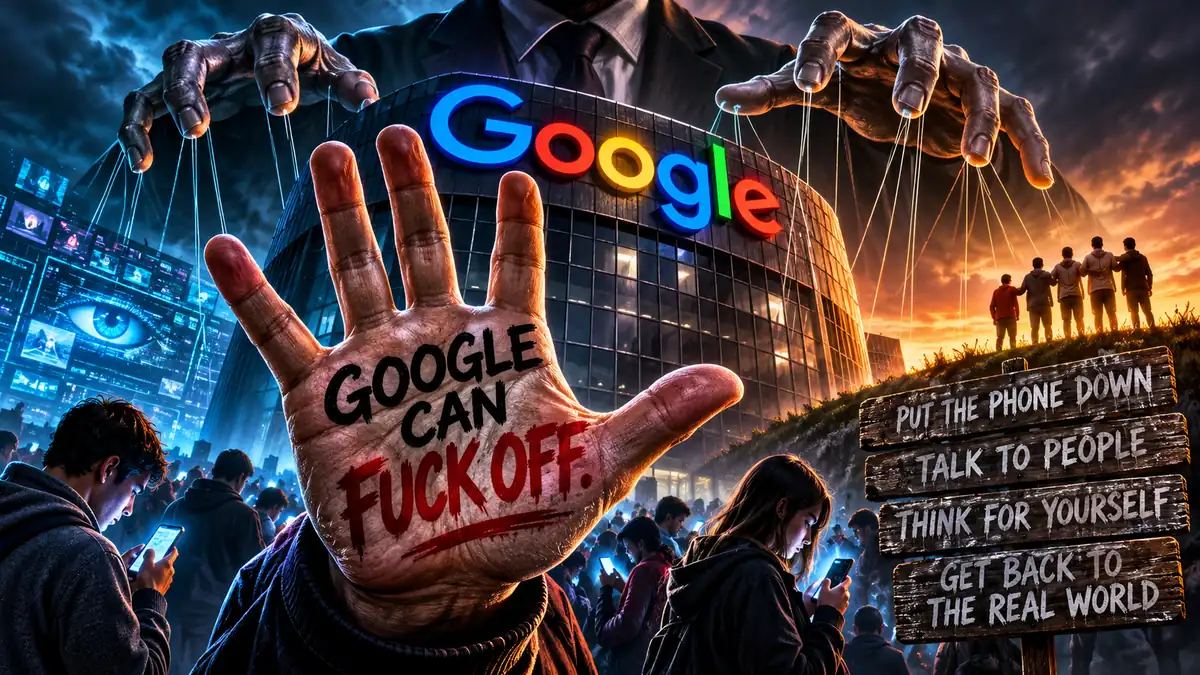
Wait.
Actually, it really can. And perhaps it’s about time we said so.
Hear me out.
The Problem With Google
Google handles roughly nine in ten searches on the planet. It owns the browser most of us use, the phone operating system most of us carry, and the advertising machinery that pays for a huge slice of the web. What you see, what you find, what gets sold to you and, increasingly, what gets answered for you: it all passes through one company’s hands.
Are you happy with that? I mean, REALLY happy with that?
Because I’m not. And I’ve earned the right to say so. I’ve run my own website since 2001. I watched the web when it was a sprawling, messy, wonderful thing, a place where you followed a link and found a person. Then I watched it get turned into a funnel.
What Google Actually Did to the Open Web
Let’s be specific, because “Big Tech bad” is lazy.
- They stopped sending people to the web. Search used to be a signpost. Now it’s increasingly a destination. AI-generated summaries sit at the top of the page, built from the work of the very sites they push further down. Why click through when the machine has already chewed it for you? Independent sites, the ones that made the content in the first place, get starved of the visitors that kept them alive.
- They marked their own homework. Courts in the US have found Google to be an illegal monopoly in search and in parts of its advertising technology. The European Union has fined it billions over the years for abusing its position. That’s not a conspiracy theory. That’s the paperwork.
- They buried the results under ads. Anyone who’s searched for something simple lately knows the scroll: sponsored this, sponsored that, then a page of SEO sludge written to please the algorithm rather than a human being.
- They treat you as the product. Your searches, your location, your habits, all of it feeds a profile that exists to be sold against. Convenience is the bait. Surveillance is the business model.
- They keep tightening the grip on the phone in your pocket. Every year the walled garden gets a little higher, and a little more of what you can install, run or change on your own device gets decided for you.
None of this makes anyone a villain in a cartoon. It makes Google a company doing exactly what unchecked power does: growing, closing doors and charging rent on the way through.
Now here’s the part that should bother you most. Search engines should help us find information, not decide what information we’re allowed to see.
And Now the Uncomfortable Bit
If you’re reading this, there’s a decent chance you’re one of the few who still likes to think for themselves. That’s becoming rare in a world run by algorithms, AI and the corporations that own them.
Because Google isn’t only a company. It’s a habit. Millions of us have handed over our curiosity without a second thought. We don’t wonder, we ask. We don’t remember, we look it up. We don’t work it out, we let the machine do it.
And more and more people spend their lives staring at their smartphones. Some seem so dependent on technology that they’ve forgotten how to think, communicate and interact without it.
I have very little time for people who would rather talk to a screen than to someone sitting a few feet away. You’re in the same room as another human being, and you’d rather message a device? What does that say about us?
It says two things:
- We’ve allowed technology to influence, and in some cases dictate, how we think and behave.
- We’ve become so absorbed in our digital worlds that genuine human interaction has taken a back seat.
I find that disturbing. And, quite frankly, bloody rude.
And before anyone points it out: yes, I’m aware of the irony. I’m telling you to put your phone down in an article you’ll probably read on one. I’m no saint. I’ve caught myself reaching for the screen when I should have been listening to the person in front of me, and so has just about everyone I know, my own family included. That’s rather the point. Nobody is immune. It takes effort.
What We Need
A return to basic social skills. Real conversations. Real friendships. Real human interaction.
Not everything needs to happen through a screen. Not every spare moment needs filling with scrolling, videos or asking AI for the answer.
Technology should serve us, not the other way round. Smartphones should make life easier, not become the centre of it. AI should be a tool, not a replacement for independent thought.
So, What Can You Actually Do?
You can’t un-invent Google. But you can stop being quite so obedient.
- Use something else. Try a search engine that doesn’t track you. Try a different browser. It’s easier than you think, and the world doesn’t end.
- Visit websites on purpose. Bookmark the independent sites you love. Type the address. Follow the link. Support the people who still make things for the open web. (And if you want to see how fast a site can be without a mountain of JavaScript, have a look at why 0 KB of JavaScript still wins.)
- Question the answer. When a machine tells you something, ask where it came from and who benefits.
- Put the phone down. Look up. Talk to someone. Actually listen to them.
Because if we carry on down this road, where technology replaces conversation, algorithms replace independent thought and screens replace relationships, we risk losing something that matters far more than any search result.
Our ability to connect with one another.
Google can FUCK OFF.
But perhaps we also need to take a long, hard look at ourselves.
Because technology isn’t going to put itself down.
We have to do that.