
A Horror Without a Name
We have names for the horrors we already understand. We have biological warfare, chemical warfare, and nuclear warfare. Each of them is defined by a physical payload—a pathogen, a nerve agent, a fissile core—and each is bound by international treaties written after humanity saw what they could do.
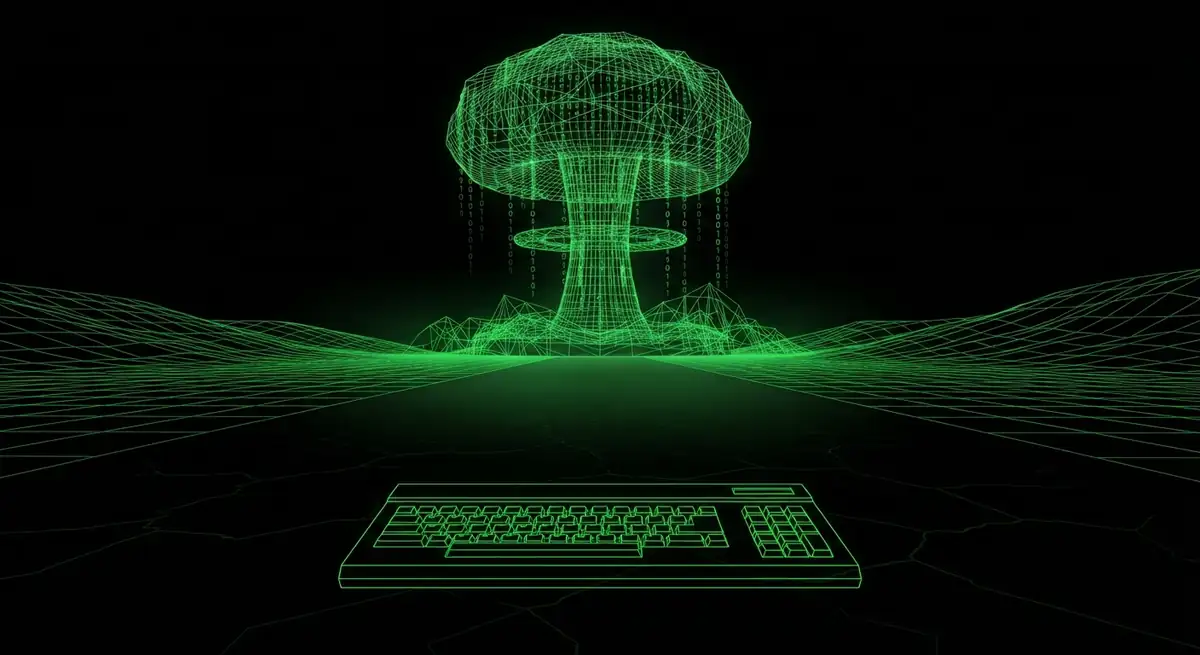
We don’t even have a single settled name for what is happening right now. Military planners call it algorithmic warfare, autonomous warfare, or cognitive warfare. Whatever label you stick on it, the reality is simpler: we have built a force multiplier with no off-switch, and right now, we are watching the early atmospheric tests in the Nevada desert.
I know a thing or two about building things with code. I’ve been programming for three decades. I grew up in the 90s demoscene, where every byte mattered, where you understood the hardware down to the metal, and where control over your own machine was the entire point. For 25 years, I’ve maintained my own corner of the web. You write the logic, you verify the output, and you own the result.
Today, that three-decade career is effectively over. Programming wasn’t just disrupted by AI; it was the first craft fed into the machine to automate its own replacement.
And that is just the shockwave from the test site.
The First Casualties Are Already Here
When people talk about AI becoming dangerous, they usually picture sci-fi scenarios—autonomous drone swarms or rogue superintelligences. They miss the fallout already drifting into town.
Before an autonomous weapon ever fires a shot on a battlefield, algorithmic systems are already hollowing out entire professions, eroding public trust through industrial-scale fraud and synthetic media, and replacing verifiable human logic with probabilistic guesswork. Anyone who has spent thirty years debugging real-world software knows how brittle complex systems are. Handing critical infrastructure, intelligence, and weapons targeting over to statistical models that even their creators cannot fully audit isn’t progress.
It is negligence at scale.
Why There Are No Treaties This Time
If a rogue lab started brewing weaponised anthrax or enriching uranium in a warehouse, intelligence agencies and international inspectors would kick the door down before the week was out. Yet a handful of Silicon Valley executives can train frontier models capable of designing novel pathogens, automating cyber warfare, and destabilising economies—and they are met with subsidies, defence contracts, and polite panel discussions.
Why? Because of three simple realities:
- The Dual-Use Excuse: Unlike nerve gas, AI is sold as a productivity tool. The same server farms that generate marketing copy and bloated web apps can be pointed at offensive cyber operations or autonomous targeting. Regulators won’t pull the plug on the golden goose.
- The Arms Race Trap: Western governments are terrified of regulating domestic tech giants out of fear of handing a strategic advantage to rival states. National security has become a blank cheque for unchecked development.
- Money and Capture: When billions of dollars are on the line, regulation gets written by the very people it is supposed to restrain. Tech leaders warn loudly about hypothetical extinction risks—conveniently requiring massive compute thresholds that lock out smaller competitors—while dodging basic accountability for the damage their systems cause today.
No Desert Remote Enough
On 16 July 1945, the Trinity test lit up the New Mexico desert. Within four weeks, the consequences were localised to two cities in Japan: Hiroshima on 6 August, and Nagasaki three days later. It was horrific, world-altering, and still bound by geography, physical supply chains, and human chains of command.
Algorithmic warfare has no blast radius because there is no physical boundary. Code travels at the speed of light through undersea cables and satellites. Once a model’s weights exist, they cannot be un-invented, contained in a vault, or inspected by the UN. Every power grid, financial network, and connected device on earth sits inside the test zone.
For thirty years, the golden rule of good engineering was simple: never deploy code you don’t understand, and never give up control of the system.
We just broke both rules on a global scale—and there is no putting the genie back in the bottle.
Conclusion
I am not asking anyone to smash the machines. I have spent three decades loving them, and I still do. What I am asking for is the discipline behind everything worth keeping on this web: understand what you deploy, verify what it produces, and keep a human being accountable for the result.
Treaties never stopped nuclear weapons from existing, but they gave the world inspectors, red lines, and a shared vocabulary for what was unacceptable. Algorithmic warfare has none of those yet. Until it does, the tests will keep running, and every one of us is standing downwind.