
The £45 Tap Water Problem
There are few modern spectacles more touching than the sight of a grown adult paying £45 for an LP that was cut from a digital master, then explaining that it sounds superior because it is “all analogue.” This is roughly equivalent to paying extra for bottled tap water because it comes in a prettier container. The water does not know. Neither does the groove.
Vinyl has enjoyed a remarkable revival over the last decade. To hear its devotees tell it, the humble LP possesses mystical properties. It offers “warmth”, “depth”, “air”, and a variety of other qualities usually associated with central heating systems and double glazing. The reality is rather less romantic, and considerably easier to measure.
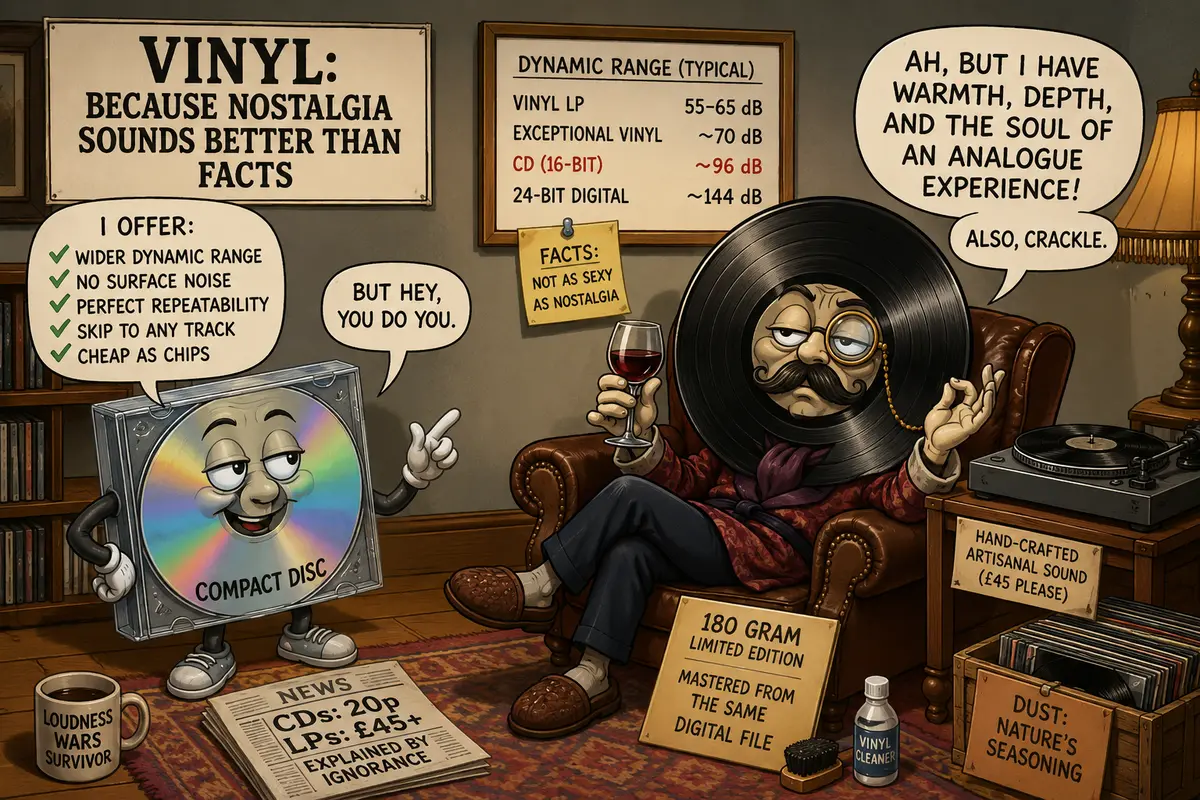
“Vinyl: Because Nostalgia Sounds Better Than Facts.”
The Vintage Costume
Most modern vinyl releases are not produced from some sacred analogue master tape guarded by monks in a candlelit vault. They are commonly cut from the same digital masters used for CD, streaming and download releases. The vinyl is often merely the last stage of a digital production chain wearing a vintage costume. The costume is charming. It is not the performance.
This does not mean vinyl sounds awful. It sounds much the same way a vintage sports car drives: charming, flawed and requiring a great deal of forgiveness from its owner. Its virtues are largely nostalgic; its shortcomings are entirely real. It does mean that many of the arguments made on its behalf are nonsense.
The Numbers That Nobody Mentions
The first problem is dynamic range: the difference between the quietest and loudest sounds a format can reproduce. The figures are not especially flattering to vinyl.
In other words, the humble Compact Disc, introduced in the early 1980s, comfortably exceeds the technical capabilities of vinyl in this crucial area. Vinyl enthusiasts sometimes respond by pointing to heavyweight 180-gram pressings or records cut at 45 rpm. These techniques can indeed improve performance, but they are essentially workarounds for the medium’s limitations. One might as well boast that a horse becomes almost as fast as a car when fitted with exceptionally expensive horseshoes.
Also, Crackle
Then there is the small matter of noise. A CD’s silence is genuinely silent. Vinyl arrives complete with crackles, pops, surface noise, groove wear and the occasional reminder that dust is one of nature’s most successful inventions. The box of vinyl cleaner in the illustration is not an accessory. It is a necessity. No one sells CD cleaner because no one needs it.
And unlike digital media, vinyl degrades with use. Every play drags a diamond stylus through a microscopic groove. The damage may be tiny, but it is cumulative. The first play is technically the best play. The thousandth play is a nostalgia trip for the first play.
What the CD Actually Did
The Compact Disc solved all of these problems over forty years ago. It offered greater dynamic range, lower noise, instant track access and perfect repeatability. And, perhaps most importantly, it offered freedom from the ritualistic gymnastics of standing up every twenty minutes to turn the thing over. Yet here we are in 2026 watching people pay astonishing sums for albums that can often be found on CD for less than the cost of a supermarket chocolate bar.
Today it is entirely possible to buy second-hand CDs for 20 pence. A quick visual inspection is usually sufficient to determine whether they will play perfectly. Most will sound exactly as they did when they left the factory decades ago. Try saying that about a used LP.
When Vinyl Actually Does Sound Better
At this point the vinyl enthusiast usually clears his throat. “But I own both versions, and the vinyl sounds better.” Fair enough. Sometimes it does. But this is where the discussion becomes interesting, because the reason is usually not the medium.
During the so-called Loudness Wars, many CD releases were mastered with aggressive compression to make them sound louder on radio and in shops. Dynamic range was sacrificed in pursuit of maximum impact. Vinyl often escaped some of this treatment because the physical limitations of the format make excessive compression and level boosting more problematic to cut.
As a result, some vinyl releases genuinely do sound better than their CD counterparts. Not because vinyl is superior. Because the mastering engineer did a better job. This distinction is crucial, and it is the one most audiophile conversations conspicuously fail to make.
The Real Bottleneck
A well-mastered CD using the full capabilities of the format can reproduce a wider dynamic range, lower distortion, lower noise floor, better channel separation and more faithful playback than vinyl can achieve under any circumstances. The medium itself is not the bottleneck. The mastering is.
The tragedy is that many audiophiles spend thousands on turntables, cartridges, isolation platforms and cables thick enough to moor a battleship, while neglecting the single factor most likely to determine sound quality: what happened in the mastering suite before the record ever reached them.
One Final Piece of Advice
Before spending £45 on a deluxe audiophile pressing advertised as being pressed on virgin vinyl under the light of a harvest moon, check the mastering first. A useful resource is the Dynamic Range Database, which will often tell you more about how an album will sound than an afternoon spent reading audiophile forums.
And unlike vinyl, the information does not wear out every time you use it.