
A Simple Answer to a Frequent Question
There is a question I am asked with surprising frequency. Why do I pay with cash whenever possible? Why do I refuse loyalty schemes? Why does my phone run GrapheneOS? Why do I avoid sharing my life online when doing so has become the cultural norm?
The answer is remarkably simple.
Privacy is not a privilege. It is a fundamental condition of a free society.
A civilisation that accepts the routine observation of ordinary people without careful scrutiny gradually alters its understanding of liberty. The extraordinary becomes ordinary. What was once considered exceptional becomes expected. Eventually, few remember that another way ever existed.
We are assured that expanding surveillance serves noble purposes. National security. Public safety. Convenience. Efficiency. These are legitimate objectives. Yet history teaches us that powers acquired during one era seldom remain confined to their original purpose. Every generation inherits the responsibility of asking not only what governments and corporations can do, but what they ought to do.
That distinction matters.
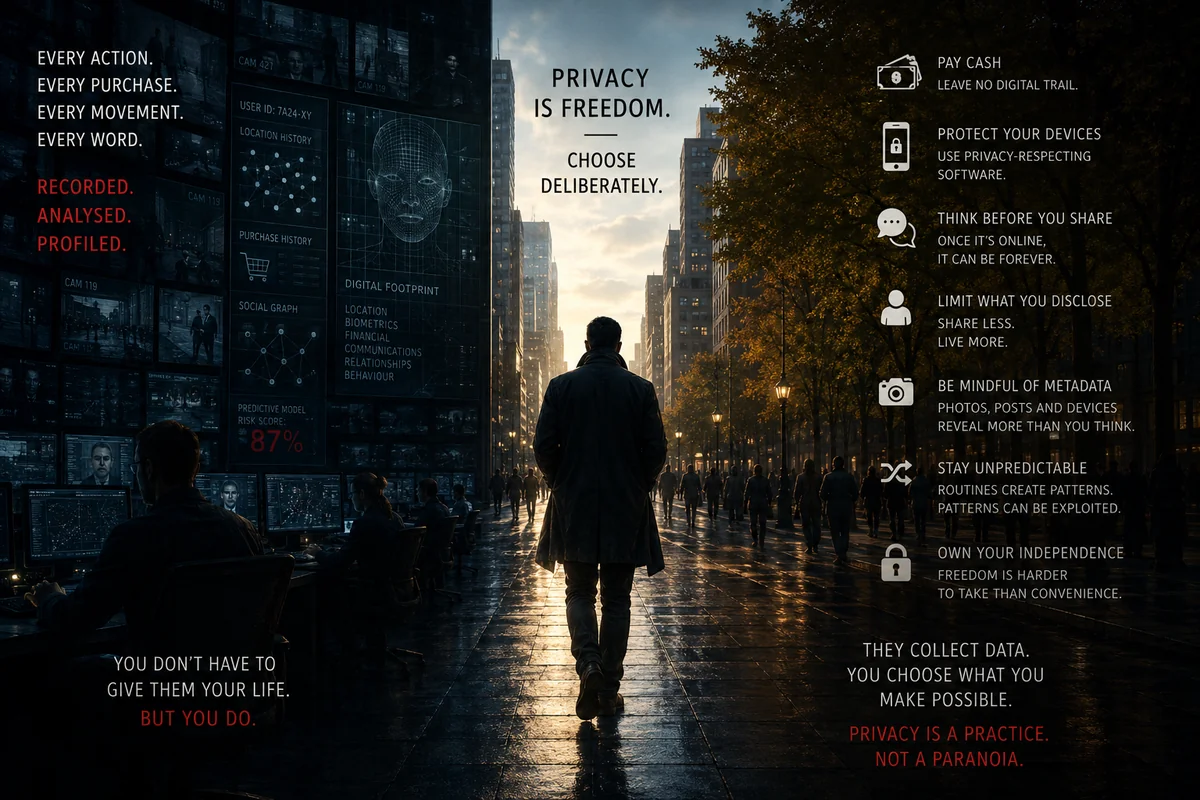
Privacy is Freedom. Choose Deliberately. — They collect data. You choose what you make possible.
The Promise of Security
Technology has transformed our ability to observe the world. CCTV systems, automatic number plate recognition, biometric identification, smartphones, connected vehicles and digital payment networks all produce extraordinary quantities of information.
There is no doubt that these technologies assist criminal investigations and improve operational efficiency in many circumstances. Yet the evidence is equally clear that surveillance alone is not a cure for crime. Studies have repeatedly shown that while CCTV can reduce certain offences, particularly vehicle crime, its effect on violent crime is considerably more limited.
Technology may assist justice. It cannot replace it. Nor can it substitute for the social conditions that reduce crime in the first place.
A Portrait Drawn in Data
Never before has humanity documented itself so completely. Every purchase. Every journey. Every search. Every location. Every interaction. Each fragment appears insignificant. Taken together, they become something altogether different.
A profile. Not merely of where you have been, but of who you are likely to become.
Patterns emerge from repetition. Habits reveal preferences. Preferences suggest beliefs. Beliefs influence predictions. This process is neither mysterious nor speculative. It is central to the operation of the modern digital economy. Information has become one of the world’s most valuable resources. We produce it continuously. Often without noticing.
Convenience Has a Cost
Most people did not consciously surrender their privacy. They exchanged it, one convenience at a time. A faster payment. A personalised recommendation. A discount through a loyalty card. A map that always knows where you are. Each decision appears trivial. Collectively, they reshape the relationship between the individual and the institutions that gather information.
This is not an argument against technology. It is an argument for understanding its price.
A photograph shared online is more than an image. It may reveal relationships, routines, possessions and locations. Even where platforms remove much of the embedded metadata, the image itself often communicates more than its creator intended. Information, once released, is difficult to reclaim.
Lessons Worth Considering
Around the world we already see examples of digital infrastructure being used to influence behaviour. China’s extensive surveillance systems and enforcement blacklists demonstrate how digital records can affect an individual’s ability to participate in everyday life. The details are often more nuanced than popular descriptions suggest, but the underlying principle remains significant: systems designed to monitor can also shape behaviour.
Democratic societies should not dismiss that lesson simply because it originates elsewhere. The question is never whether technology permits greater control. The question is where free societies choose to draw the line.
The Device We Carry
Our smartphones are extraordinary achievements of engineering. They are also extraordinary collectors of information. Location. Movement. Nearby devices. Network connections. Application activity.
Even with privacy-focused operating systems and careful habits, complete anonymity is unrealistic. Modern analysis depends less upon a single piece of information than upon countless observations assembled into recognisable patterns. Privacy today is less about invisibility than about restraint. Not every fact needs to be collected simply because it can be.
Choosing Deliberately
None of this requires withdrawal from society. It requires intention.
If privacy matters to you, begin with simple habits. Reduce unnecessary sharing. Question requests for personal information. Use privacy-respecting software where practical. Pay with cash when it makes sense. Review the permissions granted to your devices. Recognise that convenience is rarely free.
The objective is not secrecy. It is proportionality. A free citizen should decide what to disclose, to whom, and for what purpose.
The Value of Independence
Recent history has demonstrated that digital financial systems can become instruments of considerable influence. During Canada’s 2022 Freedom Convoy protests, emergency powers enabled financial institutions to freeze accounts associated with some participants. Whatever one’s view of those events, they illustrated an important reality: systems capable of extraordinary convenience are also capable of extraordinary control.
That possibility deserves careful democratic oversight. Not because abuse is inevitable. But because liberty has always depended upon limiting power before it becomes excessive.
In Closing
Every generation inherits freedoms it did not create. Whether those freedoms endure depends upon whether they are recognised before they are diminished.
Privacy is not about concealing wrongdoing. It is about preserving dignity. It is about ensuring that ordinary people retain the ability to think, travel, associate and live without unnecessary observation becoming the accepted condition of everyday life.
Progress should expand human freedom. Never quietly redefine it.
The technologies we create will shape the societies we become. The question is whether we remain their masters — or gradually become their subjects.