A Foundation, Not a Courtesy
Freedom of speech is not merely a right; it is one of the foundations upon which every free and prosperous society depends.
The ability to express ideas openly is not simply about protecting individual liberty. It is the means by which societies learn, adapt and improve. Every scientific breakthrough, every social reform and every advancement in human understanding began as an idea that someone was free to express.
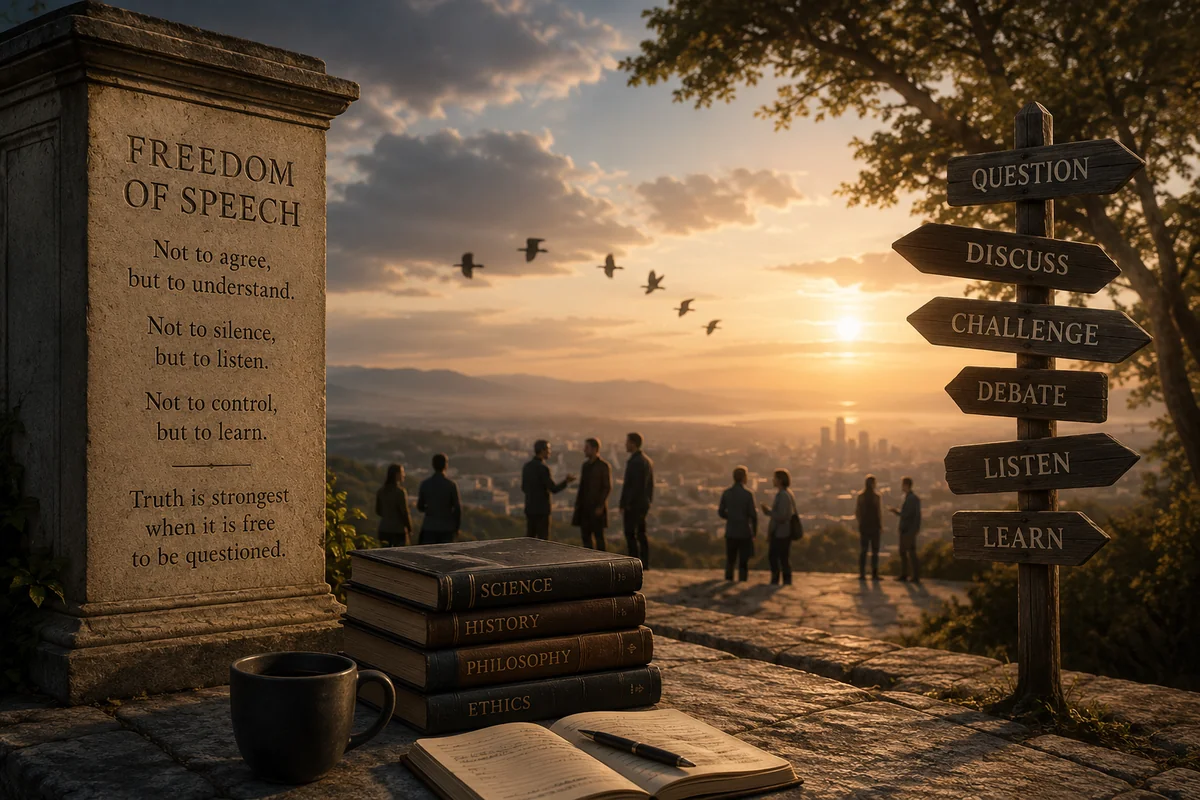
Truth is strongest when it is free to be questioned.
Harmful Ideas Must Also Come Into the Light
Equally important, harmful ideas must also be allowed into the light. When ideas are openly discussed, they can be examined, challenged and, where necessary, defeated through evidence, logic and reason. Suppressing them does not eliminate them; it often drives them underground, where they may grow unchallenged.
A society that loses the confidence to discuss difficult or unpopular ideas also loses one of its greatest strengths: its ability to correct its own mistakes.
The Gradual Erosion
History repeatedly demonstrates that governments which seek to control public discourse often do so because open discussion invites scrutiny. The restriction of peaceful expression is rarely an end in itself. More often, it is one step in a gradual erosion of the freedoms that allow citizens to hold power to account.
Where the Boundary Lies
Freedom of speech does not mean freedom from criticism, nor does it excuse threats, intimidation or direct incitement to violence. Rather, it recognises that truth is most likely to emerge when ideas compete in the open, where they can be tested by evidence instead of protected or condemned by authority alone.
As Voltaire observed, he would defend to the death the right of another to speak, even when he profoundly disagreed with what was being said. Whether or not we agree with every opinion expressed is beside the point. The principle is that a confident society does not fear conversation.
The Strength of a Free Society
Civilisation advances not because everyone thinks alike, but because people are free to question, challenge, persuade and learn from one another.
The true strength of a free society is not measured by how effectively it silences dissent, but by how confidently it allows ideas to be tested in the open. Conversation is not the enemy of civilisation; it is one of the very things that makes civilisation possible.