
An Admirable Premise
There is an old rule of technology: if you attach a reward to a measurement, people stop caring about the thing you’re measuring and start caring about the measurement.
The NHS’s proposed walking rewards scheme is based on an admirable premise. Britain moves too little, sits too much and pays the price in poorer health. If offering the occasional voucher encourages someone to swap the sofa for a stroll around the block, that is surely a victory. The difficulty begins the moment a prize enters the equation.
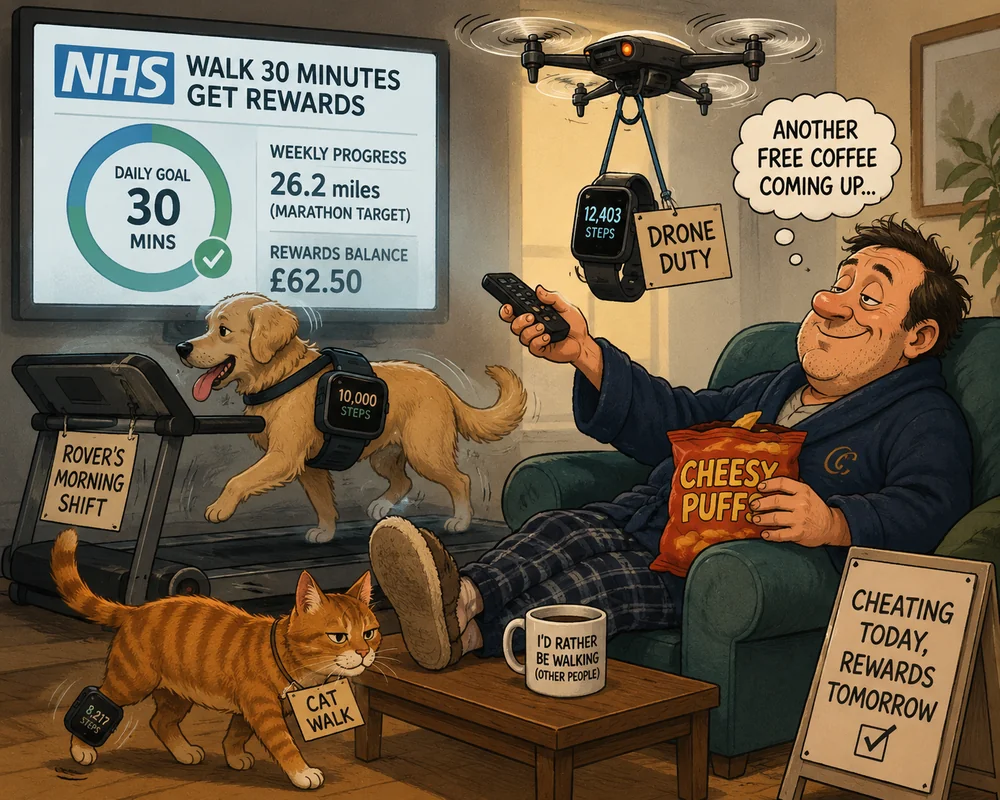
Rover’s Morning Shift. Cat Walk. Drone Duty. £62.50 rewards balance and climbing.
The Watch Knows It Has Travelled Three Miles
Consumer smartwatches are marvellous pieces of engineering, but they are fitness devices, not lie detectors. They excel at estimating movement. They are rather less gifted at determining who is actually doing the moving.
That leaves the scheme facing an awkward truth. A watch knows it has travelled three miles. It has no philosophical understanding of whether the owner travelled with it.
The Reward System Meets Human Nature
One can already imagine the reward system being subjected to the sort of creativity normally reserved for tax avoidance. A willing spouse goes for two walks instead of one. A particularly energetic teenager becomes the family fitness department. Someone lends their watch to a marathon-running friend while remaining loyally committed to the armchair.
Then come the accidental absurdities. Dogs are capable of covering astonishing distances with enthusiasm bordering on obsession. If activity is measured by movement alone, there is an obvious question about who deserves the voucher: the owner or the Labrador.
Free Stuff and the Loophole Community
Technology has spent years discovering that humans are surprisingly inventive whenever there is free stuff involved. Airlines learned it with loyalty points. Supermarkets learned it with coupons. Video games learned it with achievement systems. Every rewards programme eventually acquires a parallel community devoted entirely to finding loopholes.
None of this means the NHS should abandon the idea. It simply means it should avoid believing that data collected from consumer devices is synonymous with truth. Motion is easy to record. Genuine effort is considerably harder.
The People Who Were Going to Walk Anyway
The irony is that the people who already enjoy walking will probably use the scheme exactly as intended. The determined cheats, meanwhile, may expend more ingenuity avoiding exercise than it would have taken to complete the walk in the first place.
Perhaps that is the real lesson. Human beings have an extraordinary capacity for effort, provided the effort involves not doing the thing they were asked to do.
The Number That Actually Matters
The success of the scheme therefore won’t depend on eliminating every attempt to game the system — that would be impossible. It will depend on whether the number of people encouraged to become healthier comfortably exceeds the number who discover that, in the digital age, even a walk can acquire a black market.
Britain is inventive. The NHS is optimistic. The Labrador, at least, will definitely benefit.