
Christmas Morning, 1982
Back in Christmas 1982, my brother and I received our very first computer games console as a joint present — the Philips Videopac G7000. At the time, it felt like the future had arrived in our living room, which, given that the living room in question featured a carpet of quite astonishing geometric ambition, was saying something.
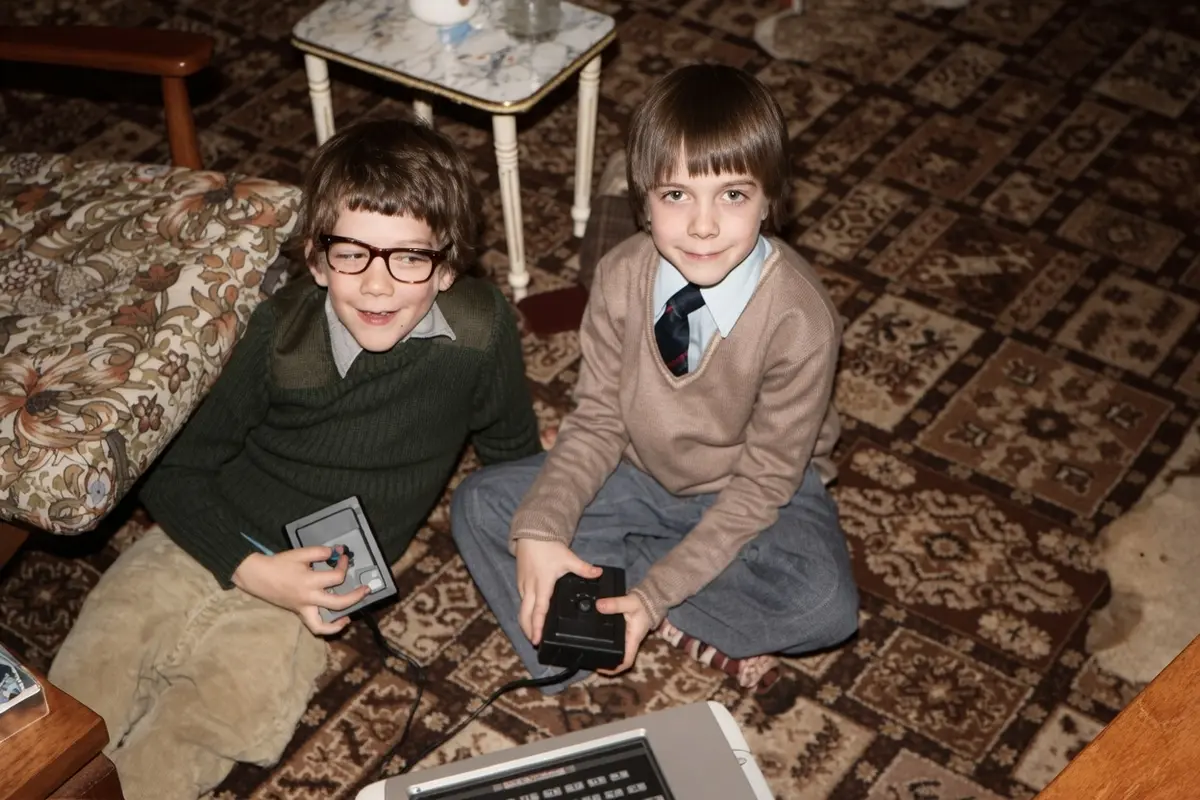
Christmas Day, 1982. My brother on the left; a five-year-old me on the right. The school tie was apparently non-negotiable, even on Christmas Day.
The console came bundled with several games along with a programming cartridge that offered an early glimpse into the world of computing. We spent countless hours glued to the television, taking turns and competing against each other on a collection of titles that, at the time, felt considerably more impressive than the hardware powering them had any right to allow.
The Games We Played
This modest collection sparked an interest in computers at an early age and set me on a path that would stay with me for the rest of my life. The machine responsible for all of this arrived with the following specifications.
The Specifications
What Survives
Today, all that remains of the console is the Space Monster cartridge. It bears the marks of time with considerable honesty. Its label has seen better days, and there is a battle scar on the handle that requires a small confession.
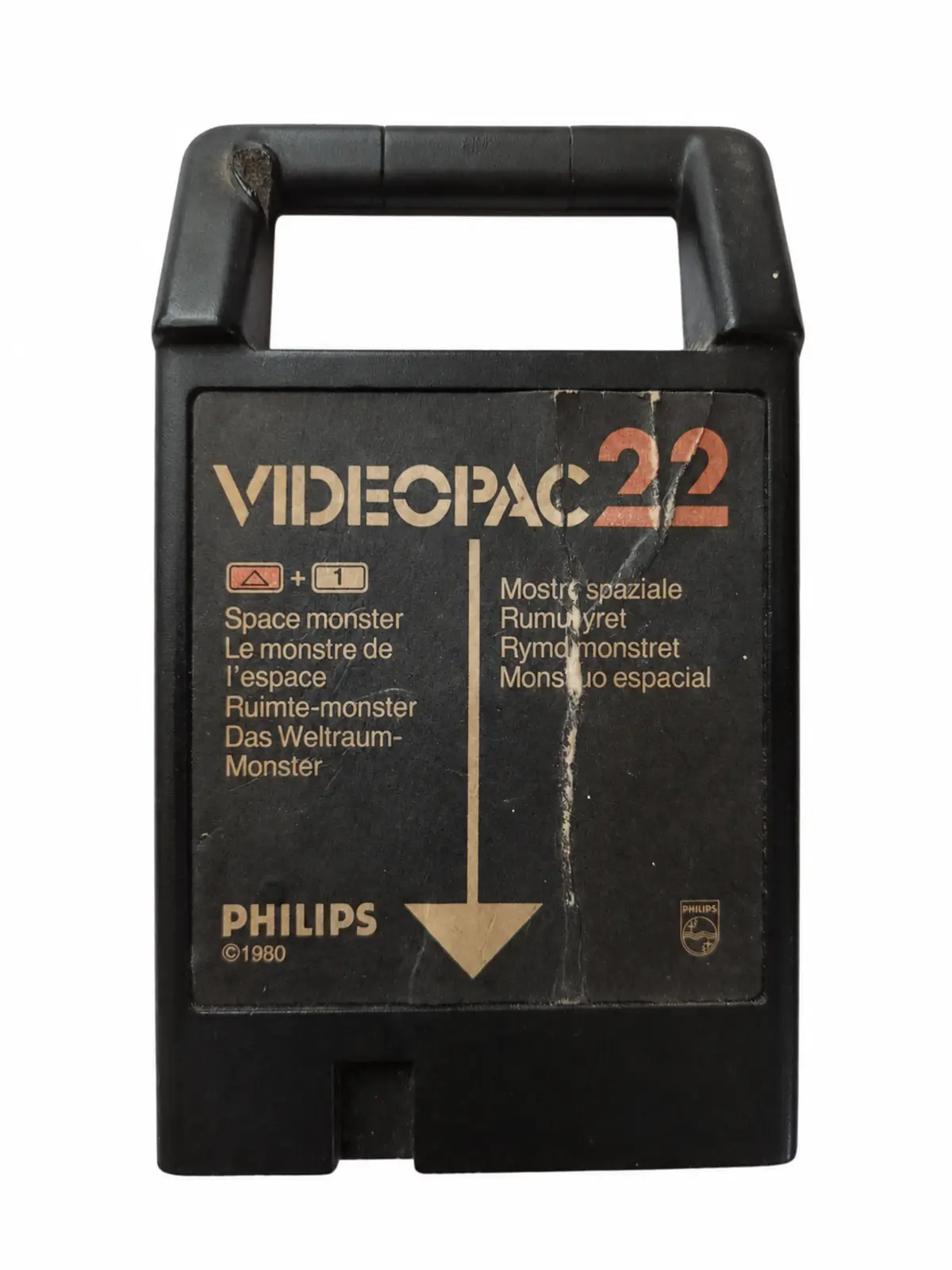
Videopac 22 — Space Monster. Philips, ©1980. The scar on the handle has a story.
At the age of eight, while attempting to repair one of the joysticks — an annual event, it seemed — I carelessly rested a soldering iron on the cartridge handle, leaving a permanent mark that remains there to this day. It is perhaps fitting that the one piece of hardware to survive from that Christmas morning should carry the earliest physical evidence of a lifelong habit of taking things apart to see how they work.
256 Bytes and a Lifetime of Consequences
The Philips Videopac G7000 is a world away from modern gaming systems. Its specifications seem almost unbelievable when set against today’s hardware: a single channel of sound, 64 lines of vertical resolution, and a RAM allocation that a modern smoke alarm would find embarrassing.
Yet what it lacked in graphical sophistication and processing power, it more than made up for in something the spec sheet does not record: the ability to keep two young brothers entertained for hours on end, and to quietly plant the idea, in at least one of them, that computers were worth understanding. The rest, as they say, is a career in IT.