A Golden Age of YouTube Revelations
We appear to be living through a golden age of YouTube revelations. Hardly a week passes without a thumbnail announcing that Quantum AI has finally solved one of humanity’s oldest mysteries. One day it has discovered who created the universe. The next it has decoded the secrets of consciousness. By the weekend it has translated the thoughts of octopuses. The only thing these miracles seem unable to locate is a peer-reviewed journal.
This is not, it should be said, an accident. Peer-reviewed journals are slow, demanding and staffed by experts who ask tiresome questions. YouTube thumbnails, by contrast, can be produced in seconds and require only a suitably dramatic font and the conviction that your audience will not check. History suggests this conviction is well-founded.
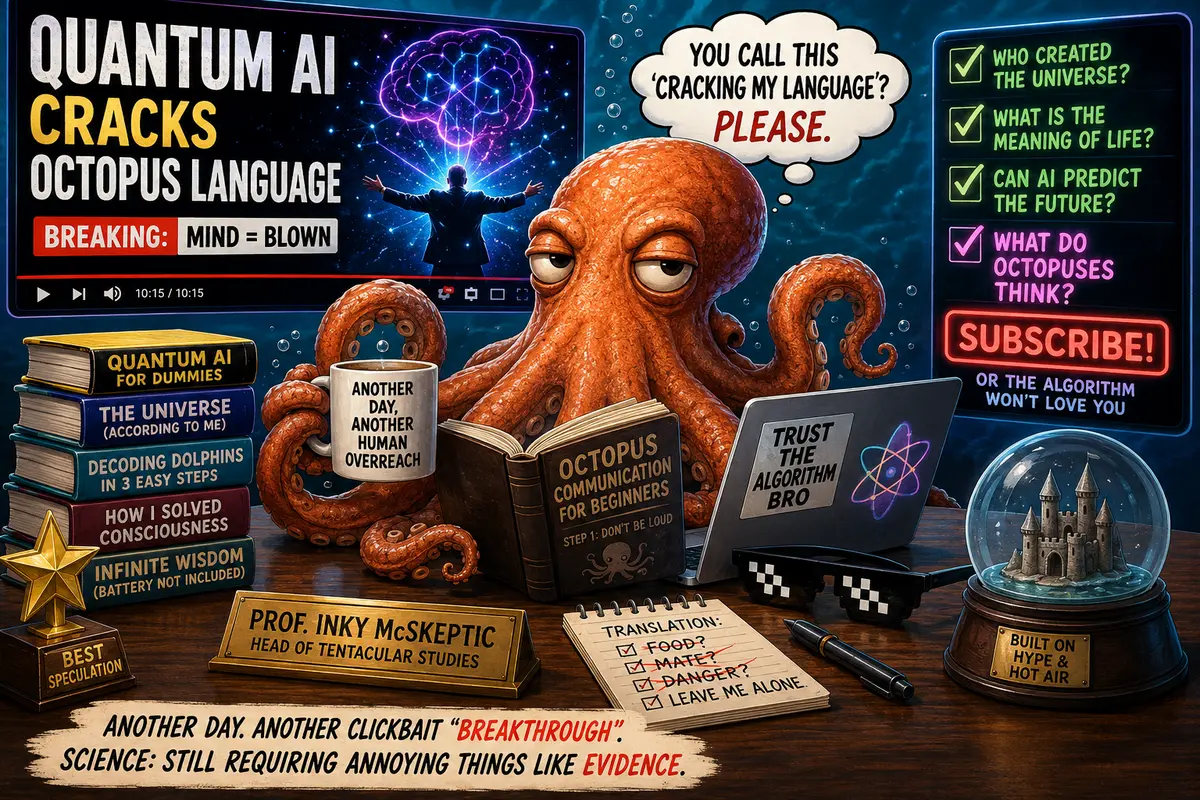
“Another Day. Another Clickbait ‘Breakthrough’. Science: Still Requiring Annoying Things Like Evidence.”
The Curious Absence of Paperwork
The claim that “Quantum AI has cracked octopus language” belongs squarely within this flourishing genre. If someone had genuinely deciphered an octopus language, it would constitute a scientific breakthrough of historic proportions. Marine biologists, linguists, cognitive scientists and AI researchers would be fighting over journal space to announce it, the way academics fight over everything: at length, in footnotes, with barely concealed fury.
Instead, what appears to be missing is the one thing science traditionally insists upon before uncorking the champagne: evidence. No peer-reviewed papers seem to support the claim. No published methodology explains how the supposed translation was achieved. No independent researchers appear to have replicated the results. There is, in short, a curious absence of the paperwork that usually accompanies a revolution in human knowledge. The revolution appears to have occurred entirely within the production budget of a ten-minute video.
The Remarkable Octopus, and What We Actually Know
The octopus is undoubtedly a remarkable creature. It can solve problems, open jars, escape supposedly secure containers and make many humans feel intellectually inadequate in ways they find difficult to articulate. These are genuine and well-documented abilities, the product of decades of patient research by scientists who published their findings and submitted them to colleagues for criticism. The old-fashioned method, in other words.
But there is a considerable distance between acknowledging that an octopus is intelligent and announcing that its language has been decoded. Indeed, there remains no scientific consensus that octopuses possess anything resembling a language in the sense implied by the video’s title. Communication of some kind, possibly. A structured linguistic system with grammar, syntax and a translation table: rather less certainly. The gap between these two positions is not a minor technical quibble. It is approximately the size of the Atlantic Ocean, with the video bobbing somewhere in the middle, unaware of either shore.
Quantum AI: A Spice with No Fixed Recipe
As for the phrase “Quantum AI” itself, it has acquired the unfortunate habit of appearing wherever a claim would otherwise sound merely implausible. Combined, the words suggest a technology so advanced that ordinary standards of verification no longer apply. Separately, quantum computing is a genuine and fascinating field with specific technical meaning, and artificial intelligence is a genuine and increasingly pervasive technology with its own specific applications. Together, as deployed in this context, they function as a kind of technological paprika: sprinkled liberally over a dish to persuade the diner that something exotic is taking place, regardless of what the actual ingredients might be.
The combination is particularly effective because most viewers are unlikely to know enough about either field to interrogate the claim. This is not an insult to viewers. It is simply an observation that the creators of such content are working with precisely calculated knowledge of what their audience does and does not know, and are optimising accordingly. It is, in its own dark way, rather impressive.
The Pogo Stick Problem
Extraordinary claims are not rendered ordinary by dramatic editing, portentous graphics, or futuristic terminology. Nor are they strengthened by narration delivered in the synthetic tones of a second-rate AI voice, bouncing through every sentence with all the natural cadence of riding a pogo stick on a bouncy castle. Scientific truth has an annoying tendency to remain unimpressed by production values. It does not care how many lens flares you have deployed, how ominous the background music is, or how many times the word “breakthrough” appears in the first thirty seconds.
What scientific truth does care about is rather more demanding: data collected under controlled conditions, methodology transparent enough for others to scrutinise, results submitted to experts who have every incentive to find fault, and conclusions that do not exceed what the evidence actually supports. These requirements have not changed because the internet exists. They have not been suspended because attention spans are shorter. They remain, with considerable stubbornness, the minimum conditions for calling something science rather than something else.
Certainty as a Content Strategy
Extraordinary claims require extraordinary evidence. This principle, which has served scientific inquiry rather well since long before YouTube was invented, applies with particular force to claims about animal cognition, where the temptation to project human frameworks onto very different kinds of minds is both understandable and historically persistent.
Until evidence appears in the form of published research, transparent data and independent verification, the sensible conclusion is not that octopus language has been cracked. It is that another YouTube channel has discovered that grandiose certainty travels much faster than scientific proof, and has made the entirely rational business decision to monetise that gap. Prof. Inky McSkeptic, Head of Tentacular Studies, appears to have reached the same conclusion. The expression on his face suggests he has been here before.
He probably has. The only surprise is that anyone is still surprised.