
Evidence
The phone sits on the table like evidence.
Scuffed plastic. Grey LCD. Rubber keys polished smooth by a thousand thumb presses. It survived drops that would shatter modern glass. The battery lasts a week. It asks almost nothing from its owner.
People mistake that for honesty. They buy one because they’re tired of surveillance capitalism. Tired of notifications. Tired of feeling watched. Somewhere along the way, the Nokia 3310 stopped being a phone and became a superstition. The story goes like this: no apps, no internet, no tracking. Privacy by subtraction.
Stories are useful. They’re easier than understanding systems.
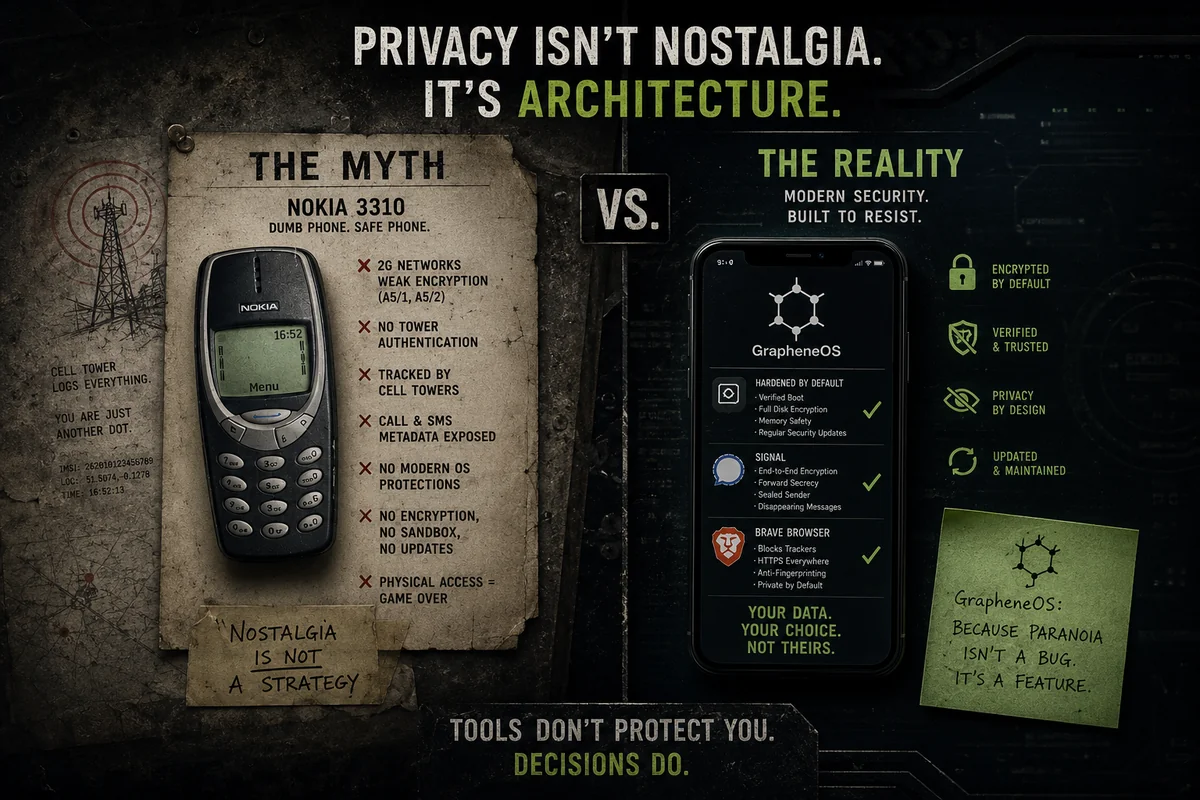
Nostalgia is not a strategy. Tools don’t protect you. Decisions do.
The Network Doesn’t Care
The moment you insert a SIM and press the power button, the handset starts talking. Not to you. To the nearest cell tower.
It identifies itself. The tower answers. The network logs where you are, when you arrived, when you left, which tower handed you to the next one, who you called and who called you. Every movement becomes another line in someone else’s database. The phone never asked for permission because that’s how cellular networks work.
The 3310 doesn’t escape that architecture. It was built for it.
GSM
People hear the word encryption and stop asking questions. They shouldn’t.
The original GSM standards were designed in another century, when the biggest thing in your pocket had a monochrome display and the biggest concern was battery life. The handset authenticates to the network, but the network doesn’t authenticate itself to the handset. That’s backwards. It means a fake base station — a cell-site simulator, an IMSI catcher — can pretend to be a legitimate tower and many older devices will believe it.
Trust is expensive. Blind trust is cheap.
The air between your phone and the tower isn’t sacred. It’s radio. Radio can be listened to, manipulated, downgraded and, under the right conditions, intercepted. Older GSM encryption algorithms have long-standing weaknesses. Some are obsolete. Some can be broken. Some can simply be switched off if the network allows it.
Your Nokia doesn’t object. It can’t.
Infrastructure
None of this is visible. That’s why the myth survives.
People think surveillance begins with Facebook. It doesn’t. It begins with infrastructure. A smartphone can betray you because you installed the wrong app. A Nokia 3310 betrays you because it faithfully obeys the network it was designed to trust.
And that’s before you even look inside the device.
No verified boot. No modern application sandboxing. No meaningful full-disk encryption. No rapid security updates. No hardened memory protections. If someone gets physical access to the handset, there’s very little standing between them and whatever lives inside it.
People call that simplicity. Engineers call it missing features.
What Security Actually Means
Security isn’t about owning less technology. It’s about owning technology that assumes every component can fail, every network can lie, every application can be hostile, and every attacker only has to be right once.
That’s why a properly hardened smartphone running GrapheneOS is objectively more secure than a twenty-year-old feature phone. Verified boot detects tampering. Full-disk encryption protects stored data. Sandboxing contains compromise. Frequent security patches close holes before they’re weaponised.
Pair it with Signal and your messages become encrypted before they ever touch the carrier’s network. Use registration lock, disappearing messages and sealed sender, and you’ve moved the trust boundary away from the phone company and towards the people actually having the conversation.
Browse with Brave and you’re no longer volunteering your browsing habits to every advertising network that can execute a script.
Harder to Compromise Is Engineering
None of this makes you invisible. Invisible is fiction. Harder to compromise is engineering. That’s the difference.
The Nokia 3310 isn’t dangerous because it’s old. It’s dangerous because people believe it protects them.
The most effective exploit has never been software.
It’s confidence.