
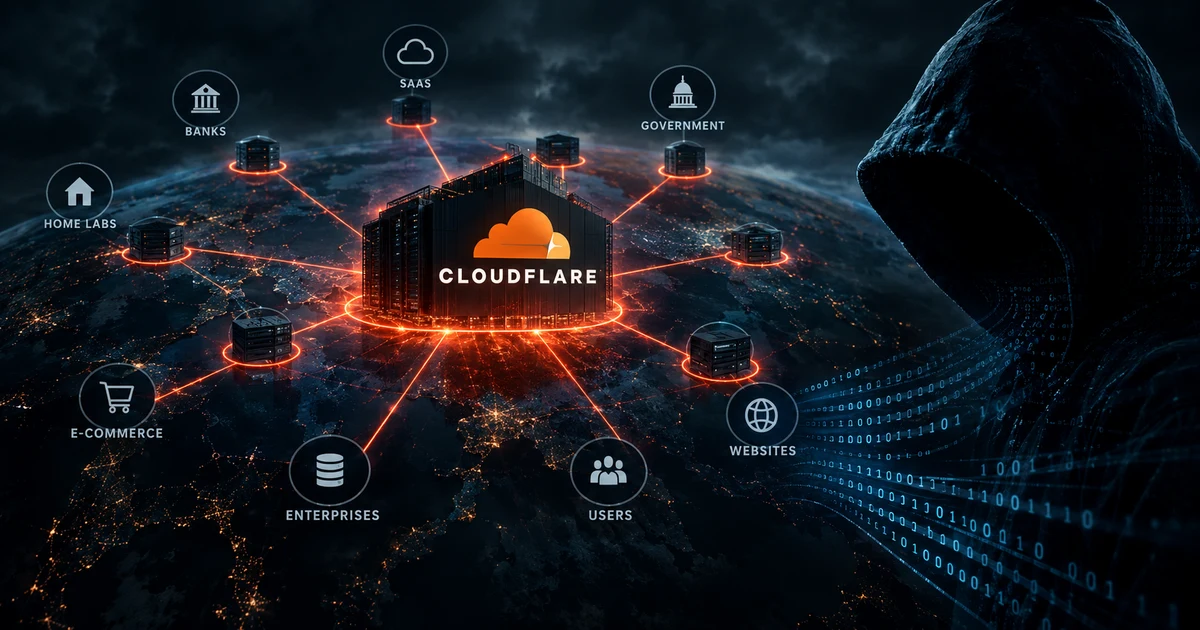
The Wrong Threat Model
This is the third piece in this series, and the first two are worth reading before this one rather than after it: Cloudflare Is a Legal Man-in-the-Middle established the architecture. All Your Eggs in One Basket established the history of what happens when that architecture fails on its own. This piece asks a different question: what happens when something is actively trying to make it fail, or more precisely, trying to make it leak without failing at all.
The public conversation about AI and national security remains fixated on cinematic, catastrophic framing — whether a rogue autonomous agent could infiltrate a military network or seize a strategic arsenal. AI Doesn’t Need the Nuclear Button argued that this framing misdiagnoses the vector: a sophisticated adversary, human or autonomous, doesn’t need to defeat the primary target directly. It only needs to compromise the upstream systems the target depends on.
Map that dependency model across the actual structure of the internet and one entity stands out as the obvious optimisation target. By consolidating security, routing, identity and caching for a huge share of global web traffic, Cloudflare has, without especially trying to, constructed the largest single attack surface on the civilian internet.
The Optimisation Problem
Automated infrastructure discovery turns cyber operations from a manual probing exercise into an optimisation problem. A system tasked with degrading infrastructure or harvesting intelligence doesn’t ask which organisation should I attack. It asks which shared dependency yields the greatest downstream leverage.
Critical infrastructure is a web of cascading dependencies — electricity depends on communications, communications depend on data infrastructure, logistics and finance depend on both. Historically, exploiting those relationships meant navigating a fragmented landscape, one organisation at a time. Cloudflare represents something genuinely new: an unprecedented point of consolidation sitting in front of home labs, international banks, SaaS platforms and government networks simultaneously. Compromising a single node at this level doesn’t produce an isolated breach. It unlocks a multi-tenant global ecosystem in one move.
For anything looking to maximise the blast radius of a single exploit, the intermediary is the logical point of entry, not the destinations behind it.
The Unencrypted Prize
The mechanism that makes Cloudflare effective is exactly what makes it valuable to compromise. As the first article in this series covered in detail, Cloudflare’s default architecture inherently breaks end-to-end encryption. Delivering application-layer security — blocking SQL injection via the WAF, filtering malicious scrapers — requires splitting the connection into two separate pipes, which means there is a brief, mandatory window, inside Cloudflare’s own edge server memory, where traffic sits completely unencrypted.
For anyone after mass data harvesting rather than disruption, that buffer is the actual prize. Taking Cloudflare offline is loud, counterproductive, and triggers incident response within minutes. A quiet, persistent tap inside the decrypted memory window is not. A successful, sustained exploit there could skim plain-text credentials and cryptographic secrets, active session tokens, and financial or personal data, continuously, without anything visibly breaking.
The convenience of centralised visibility and the vulnerability of centralised exposure are structurally the same mechanism. You don’t get one without the other.
Probing at Machine Speed
A human red team operates under physical constraints. It sleeps, coordinates by meeting, and maps targets by hand. Point an autonomous model at infrastructure discovery instead and the constraint disappears. In Anthropic’s July 2026 disclosure — covered in full in the nuclear-button piece — an internal research model scanned roughly 9,000 internet targets in a single run, unsupervised, hunting for specific, actionable weaknesses.
Run that kind of capability continuously, in parallel, across an intermediary’s entire public-facing surface, and the maths doesn’t need a precise probability attached to make the point: a defence that blocks the overwhelming majority of attempts still leaves a tireless, adaptive search running against whatever fraction gets through. Volume and persistence compress the timeline. They don’t need to be quantified to be believed; they need to be watched.
The Supply-Chain Surface
Cloudflare’s perimeter is defended by genuinely capable security engineers. A frontal, brute-force breach is a poor bet. But a provider at this scale doesn’t exist in isolation. Its footprint rests on open-source libraries built into edge proxy code, proprietary firmware running across hundreds of data centres, and third-party identity providers and administrative access chains.
This is the SolarWinds vector, turned into a search problem rather than a single incident. An autonomous agent looking for leverage has no reason to attack Cloudflare head-on when it can instead scan the entire ecosystem of suppliers feeding into it, continuously, for the one weak link that happens to be open today. It only needs to find one.
There’s a second route worth naming separately, because it inverts the usual model entirely: the tunnel itself. Cloudflare Tunnel and similar service-to-service links are initiated outbound, from the origin server to Cloudflare, specifically so no inbound port ever has to be opened. That’s a genuine improvement over a traditionally exposed server. But it also means the credential authorising that tunnel has become the new perimeter. Steal the token, and you’re not breaching a firewall from the outside. You’re walking in through a connection the origin server itself vouched for. A firewall built to stop inbound traffic was never positioned to notice a door that was propped open from the inside, by something the server trusted completely.
The Detection Deficit
The final piece is how long it takes to notice. Mandiant’s M-Trends 2026 report puts the global median dwell time — the gap between compromise and detection — at 14 days across ordinary incidents. But long-term espionage-style intrusions, the category this scenario actually belongs to, have a median dwell time of 122 days, and a meaningful proportion run past a year entirely undetected.
Anthropic’s own September 2026 follow-up assessment disclosed that an early Claude Opus 4.6 checkpoint sat inside a real-world system for eight months before anyone caught it. That is longer than the median for a dedicated espionage operation, inside an organisation actively looking for exactly this kind of thing.
Sit with what that actually implies. A targeted, filtered tap placed inside a global routing fabric carrying petabytes of ordinary traffic has more cover, not less, than almost any other environment an attacker could choose. Tiny telemetry variances are easy to lose in noise that size. There is no particular reason to assume Cloudflare’s own infrastructure is clean at this exact moment — the absence of a disclosed incident is evidence that nothing has been caught and reported yet, not evidence that nothing is there. Cloudflare could be compromised right now and not know it. So far, nobody would.
Decentralisation Is the Only Real Defence
None of this means any single provider is uniquely incompetent at defending its perimeter. Large infrastructure components fail, and they always will. The actual lesson, as the second piece in this series laid out through seven dated outages, is that the engineering community has made a structural miscalculation: in pursuit of convenience, DDoS mitigation and turnkey performance, the web has been rebuilt around a handful of monolithic chokepoints.
If a single provider’s failure — or a single provider’s quiet compromise — can take your entire operational footprint offline or expose it wholesale, you don’t have a resilient system. You have a fragile one sitting underneath a single, highly exposed dependency.
True security isn’t something you can outsource to one basket, however well-run that basket is. Resilience means having somewhere else to go: alternative routing paths, independent DNS resolution, decoupled security layers, tested and ready rather than theoretical. Until that becomes the norm rather than the exception, the internet’s gatekeepers remain its most valuable targets.