The Alchemy That Nobody Could Quite Explain
For years, SEO occupied that curious territory somewhere between medieval alchemy and organised religion. Everyone claimed to understand it. Nobody could quite explain why it worked. The small independent developer approached it in much the same spirit as a peasant studying the stars: hopeful, bewildered, and aware that the important decisions were being made elsewhere.
The problem was never merely technical. It was economic. Search engine optimisation rewarded those with the time, manpower and budget to pursue an endlessly shifting target. Google’s ranking algorithm changed with the regularity of a nervous aristocrat changing outfits, while the rules governing backlinks, authority scores and content quality remained cloaked in enough secrecy to make the Coca-Cola recipe seem like open-source software.
For the lone developer, this produced a familiar arrangement. One would write good code, produce useful content, observe the latest SEO commandments handed down from Mountain View, and then wait. Occasionally a visitor would arrive, much as a rare bird might land in the garden. It was not a strategy so much as a form of faith.
“You Have the Content. We Have the Audience.”
Then the Barbarians Breached the Gates
Then artificial intelligence arrived and, for a brief and glorious moment, it looked like the barbarians had finally breached the gates. Suddenly, anyone could ask a large language model to digest the latest mountain of SEO advice, identify profitable keywords, structure pages correctly and suggest optimisation strategies. Work that previously required agencies, consultants and invoices containing alarming numbers could now be accomplished with a carefully written prompt and a cup of coffee.
To its credit, it worked. A search for “Pure PHP Minesweeper” currently places FS HOT at the top of Google’s first page. That achievement would once have required a campaign plan, an SEO specialist and perhaps a minor blood sacrifice. Instead, it was accomplished largely through intelligent use of AI tools and a willingness to experiment.
Which brings us neatly to the problem.
The Student Who Forgot to Mention the Sources
The same technology that helped independent sites climb Google’s rankings is now helping Google eliminate the need for visitors to click those sites in the first place. Google’s AI Overviews and similar generative search features increasingly answer users’ questions directly on the results page. The search engine no longer behaves like a librarian directing you towards a shelf. It behaves like a student who has borrowed every book in the library, condensed them into a paragraph and then forgotten to mention where the information came from.
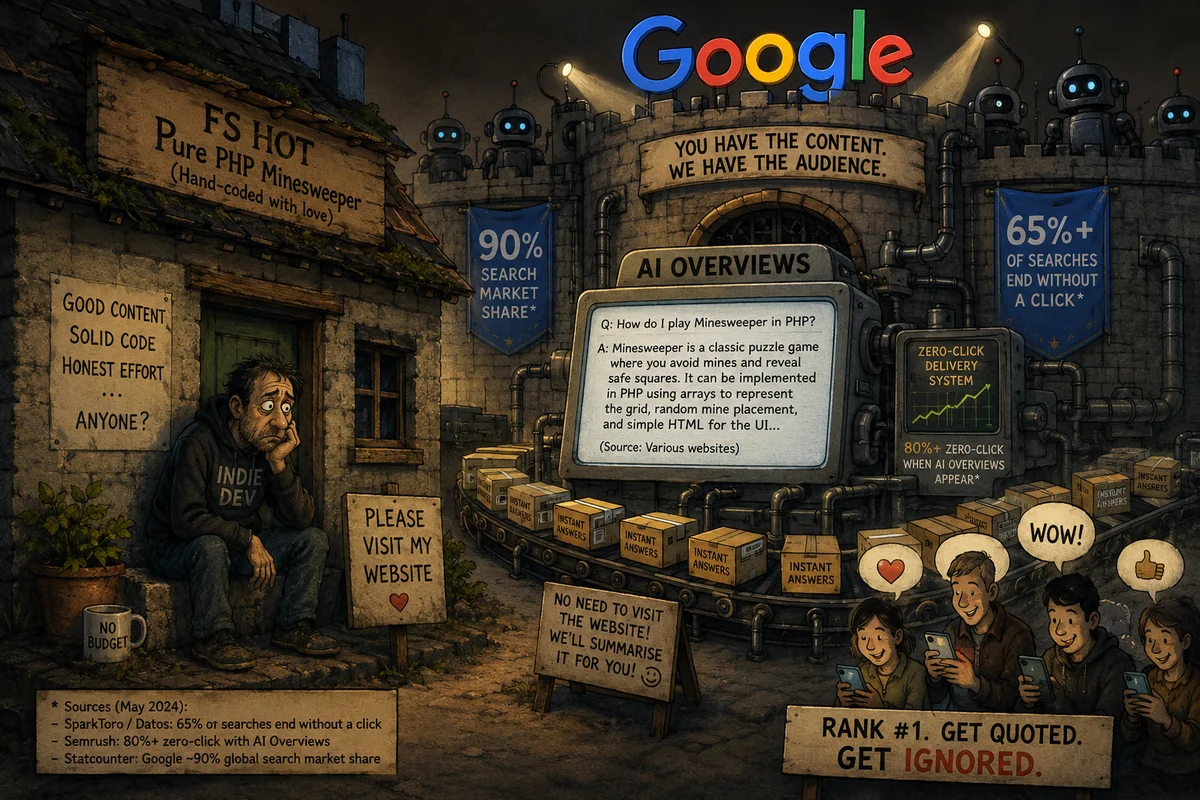
The numbers are becoming difficult to ignore. Recent studies estimate that more than 65% of Google searches now end without a click to any external website. When AI-generated summaries appear, that figure rises above 80% for many informational searches. Some analyses suggest that websites occupying the coveted number-one position have lost between 30% and 60% of their click-through traffic when AI Overviews are present. Publishers across multiple sectors report traffic declines ranging from 20% to over 40% since Google’s AI features became widespread.
The Magnificent Irony
This creates a magnificent irony. For two decades, website owners were encouraged to produce useful content so that search engines could discover, index and rank it. Then AI arrived and demonstrated that the most useful thing a search engine can do with your content is often prevent anyone from visiting your website at all. The reward for success is becoming invisibile.
The illustration above captures the transaction with uncomfortable accuracy. The indie developer — good content, solid code, honest effort, no budget — sits outside his hand-coded cottage with a cardboard sign that says “Please Visit My Website” and a heart, because nothing else remains. Inside the Google castle, the AI Overviews machine processes his Minesweeper article into a tidy paragraph citing “various websites” while delighted users tap their phones and go “Wow!” without ever needing to leave the results page. The zero-click delivery system graph points cheerfully upward. Rank number one. Get quoted. Get ignored.
Brand Awareness, and the Cheques That Have Not Arrived
The SEO industry, never knowingly caught without a fresh buzzword, now insists that “brand awareness” is the answer. Apparently the future belongs to recognisable brands rather than websites dependent on search traffic. Wonderful. One can only assume that the same experts who spent years selling keyword strategies, backlink campaigns and optimisation audits will soon be distributing the substantial budgets required to build a recognisable brand. Independent developers everywhere await their cheques with mounting anticipation.
Meanwhile, Google continues to dominate search with roughly 90% of the global market, meaning most website owners have little practical choice but to keep playing the game. The difference is that the rules have changed. Ranking highly is no longer enough. Being quoted by the machine has become more important than being visited by the human.
The Website, Waiting for a Visitor Who May Never Arrive
The old web was built on links. The new web is increasingly built on summaries. And somewhere, hidden beneath layers of AI-generated answers, optimised snippets and algorithmic certainty, sits the original website, patiently waiting for a visitor who may never arrive.
The “No Budget” mug says it all. Hand-coded with love. Cited by the machine. Visited by nobody. The Google castle lights blaze on, the instant answers conveyor belt rolls forward, and the independent developer sits quietly in the dark wondering whether the rare bird will ever land in the garden again.