
The Distinction Nobody Makes
Most people don’t hate advertising. If they did, billboards wouldn’t exist. Newspapers would never have made money. Television would have collapsed decades ago. People understand that businesses need customers.
What people hate is being interrupted. The distinction matters.
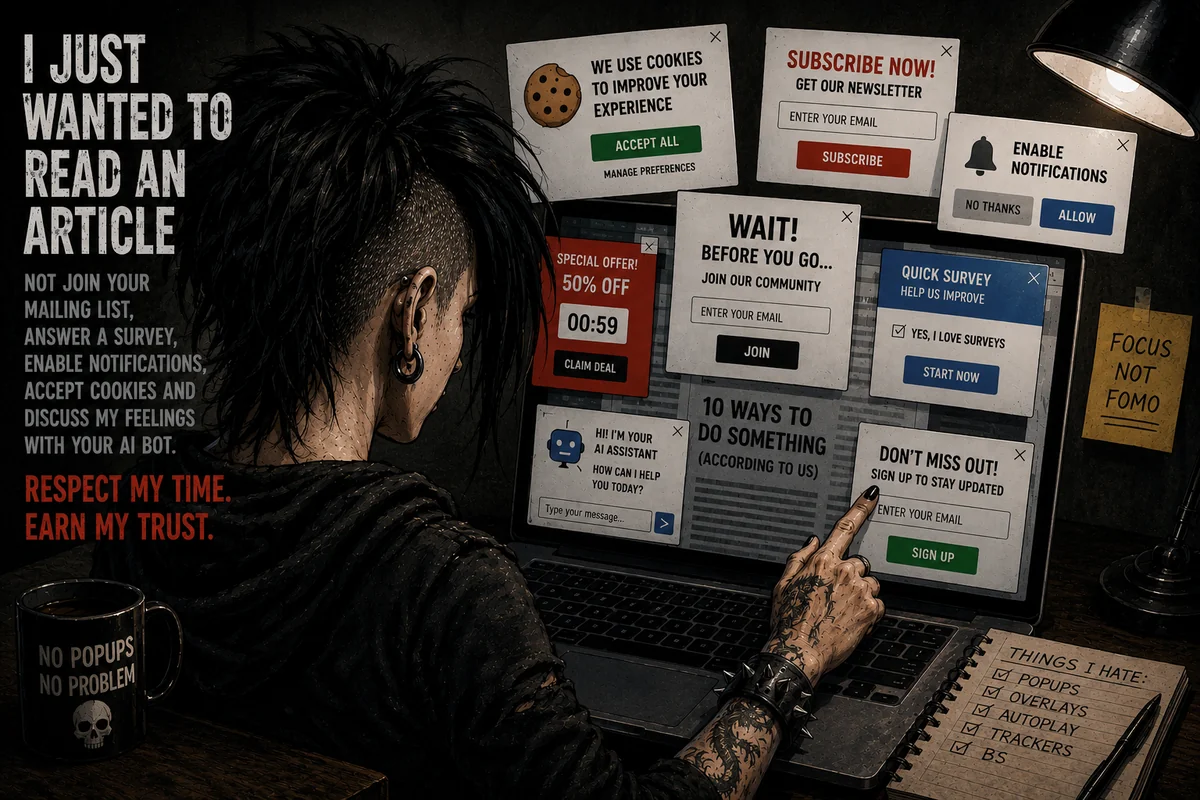
“I just wanted to read an article.”
A Person Arrives With an Objective
A person visits a website because they want something. An article. A guide. A review. A phone number. A recipe. Whatever it is, they arrived with an objective.
Then the website decides its objective is more important.
Before the article appears, a popup demands an email address. Another asks for notification permissions. A third wants consent for enough cookies to open a small bakery. The user hasn’t read a single word yet, but apparently a relationship is already being proposed. This is strange behaviour. In the physical world it would be considered rude.
The Bookshop
Imagine walking into a bookshop. Before you’ve looked at a single book, an employee steps in front of you.
“Would you like to join our mailing list?”
“No.”
“Would you like notifications?”
“No.”
“Can we track your movements around the shop?”
“No.”
“Would you like to talk to our AI assistant?”
“No.”
Most people would leave. Online, this happens every day. The surprising part is not that websites do it. The surprising part is that anyone thinks it works.
What Actually Happens
I’ve watched people attempt to read articles online. Not technical users. Ordinary users. The reaction is often immediate.
The article loads. A popup appears. The user swears. The tab closes.
End of interaction. No sale. No subscription. No engagement. Just irritation. The website measured an impression. The visitor remembered an annoyance. Everybody lost.
Nothing Has Been Earned
The theory appears to be that if somebody visits your site, you should ask for something immediately. An email address. A subscription. A registration. A survey. A commitment. Anything.
The flaw in the logic is obvious. The visitor hasn’t received anything yet. Nothing has been earned. Trust doesn’t appear because somebody landed on a page. Trust appears after value is delivered.
If I read an article and find it useful, asking whether I’d like more articles is reasonable. If I use a tool that solves a problem, offering updates is reasonable. If a website helps me, I might choose to return. This is not complicated.
The Sequence Matters
Provide value. Then ask. Not the other way around.
The most effective approach is often the least aggressive. A simple form at the bottom of an article. No popup. No animation. No countdown timer. Just a sentence: “Enjoyed this article? Subscribe for future updates.” That’s it.
The reader has already made a decision. They finished the article. They found it useful enough to reach the end. Now the request makes sense. The website has earned the right to ask.
The Arms Race Nobody Needed
Meanwhile, entire industries continue searching for increasingly elaborate ways to demand attention. Popups. Slide-ins. Overlays. Autoplay videos. Artificial urgency. Exit-intent traps. Every year the technology becomes more sophisticated. Every year more users install software designed to avoid it.
That should tell us something.
People are not fighting advertising. They are fighting interruption. Those are different things. Advertising respects attention. Interruption assumes ownership of it. One works. The other creates ad blockers.
The Lesson That Should Never Have Been Forgotten
Eventually websites will relearn it. Visitors arrive for the content. Not the popup. Not the newsletter. Not the marketing funnel. The content.
Respect that objective and people may stay. Ignore it and they’ll leave. Usually while muttering something unprintable.