A Tool Mistaken for a Place
Most people use “Tor” and “the Dark Web” as if they’re the same thing. They are not. Tor — short for The Onion Router — is a piece of software. The Dark Web is a place, or rather a category of places, and Tor is the only route in. Confusing the two is like confusing a road with one specific, hidden destination that road happens to lead to. What follows separates the tool from the territory, explains how the tool actually works, and gives a clinical account of what’s really down there.
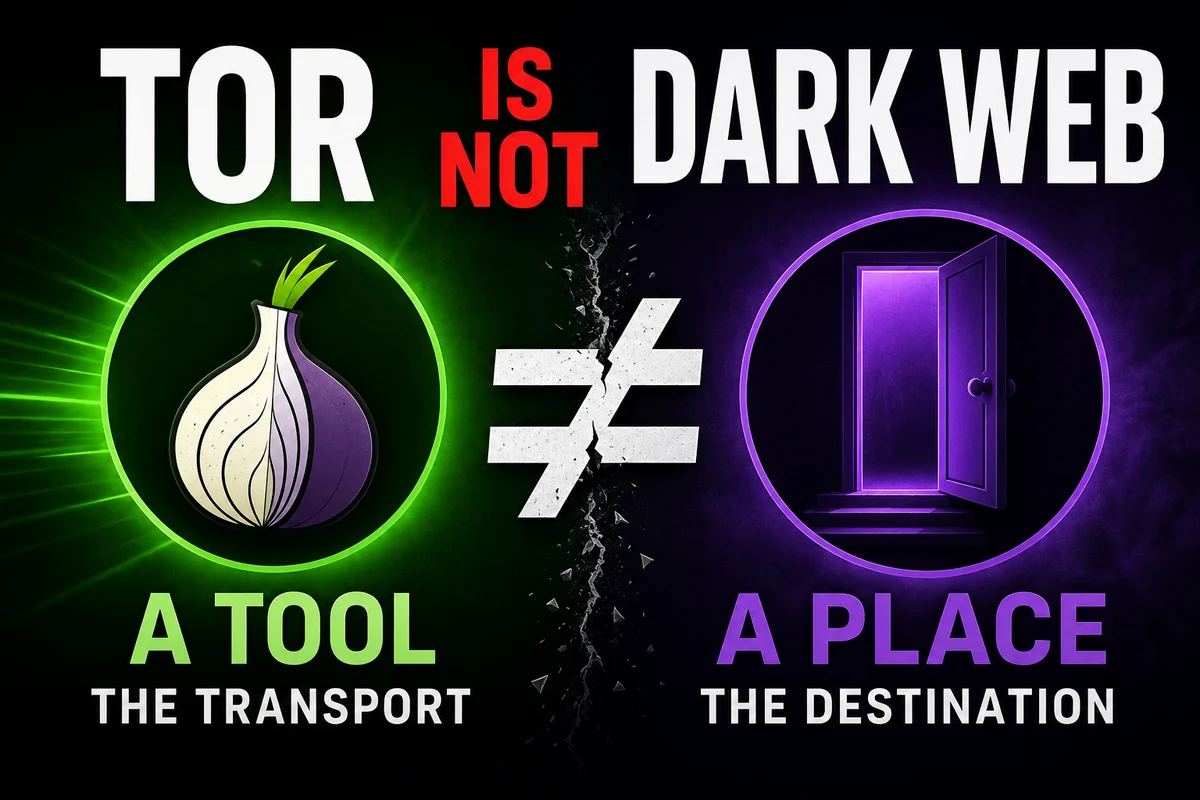
A tool and a place. Confusing them is where most of the confusion starts.
What Tor Actually Is
Tor — The Onion Router — is a network designed to hide who is talking to whom. It does this through a technique called onion routing, and the name is not decorative. It describes the mechanism.
When your device sends data through Tor, it doesn’t connect directly to the destination. Instead it builds a circuit through three relays, chosen at random from thousands of volunteer-run servers worldwide:
- The guard relay — the first hop, the only one that sees your real IP address.
- The middle relay — knows only that it’s passing traffic between the guard and the exit.
- The exit relay — the last hop, which sends your request on to its final destination and sees the destination but not you.
Before any data leaves your device, it is wrapped in three layers of encryption, one for each relay — like a letter sealed inside an envelope, sealed inside another envelope, sealed inside a third. Each relay can only remove one layer, its own, revealing just enough information to know where to pass the parcel next. It cannot see what’s inside the deeper layers, and it cannot see the whole route. No single relay in the chain knows both who sent the data and where it’s ultimately going. That separation of knowledge is the entire security model. Break one relay and you learn nothing useful; you’d need to control and correlate all three simultaneously, which is precisely why the system is built on three independent, randomly-assigned hops rather than one.
This is also why Tor is slower than a normal connection or a VPN. Your traffic is taking a deliberately indirect, encrypted, three-hop detour instead of a straight line.
Three hops is the default for a reason, not a limit imposed by the software’s capability. Tor Browser fixes it there deliberately: it’s the minimum needed to guarantee no single relay knows both ends of the connection, and adding more hops adds latency without adding meaningful security. Advanced users can adjust preferences within that model — restricting which country an exit relay is chosen from, for instance, via Tor’s own configuration file — but Tor deliberately limits how much of the route you can hand-pick outright. Letting a user choose their entire path would let an attacker choose it too.
What Tor Is Actually For
Tor’s job is anonymity, not illegality. The overwhelming majority of Tor traffic goes to perfectly ordinary websites on the normal, indexed internet — it simply arrives there without revealing where it came from.
This matters for anyone whose safety depends on not being traced: journalists communicating with sources, whistleblowers, activists and dissidents operating under hostile governments, people escaping surveillance or abuse, and ordinary users who simply object to being tracked as a matter of principle.
It’s worth comparing Tor to a VPN directly, because they solve a similar problem with a different trust model.
Tor vs VPN A VPN routes your traffic through one company’s server. Your ISP no longer sees it — but you are now trusting that VPN provider entirely, since it alone can see both who you are and what you’re doing. Tor removes that single point of trust by splitting the knowledge across three independent, unrelated relays, none of which can see the full picture alone. For genuinely high-risk use — where the VPN provider itself could be compelled, compromised, or simply lying about its no-logs policy — Tor’s distributed model is the more defensible choice.
What the Dark Web Actually Is
The Dark Web refers specifically to websites hosted as Tor hidden services, addressed with a .onion suffix instead of .com or .co.uk. These are not indexed by Google, Bing, or any conventional search engine, and they cannot be reached with an ordinary browser. Reaching one requires Tor specifically, because the address itself is derived from Tor’s own encryption keys rather than assigned by the standard domain name system.
That last detail is why .onion addresses are non-geographical in a way ordinary websites are not. A regular domain resolves through DNS to an IP address that maps, one way or another, to a physical server in a physical country. A .onion address resolves through Tor’s own internal routing instead — it is generated from a cryptographic key, not registered against any real-world location, and never touches conventional DNS at all. The site still runs on a physical machine somewhere, but the addressing system itself carries no geographical information and cannot be used to locate it. This is the same onion-routing technology described above, just applied to the receiving end of the connection as well as the sending end — both the visitor and the site are cloaked from each other by the same layered mechanism.
There’s a further detail that makes this even more watertight than reaching an ordinary site through Tor. When you visit a normal website via Tor, your traffic still has to leave the Tor network somewhere — at the exit relay — before it reaches that site, and the destination server sees the exit relay’s address, not yours. But a .onion address never requires that final exit at all. Your browser builds its usual three-hop circuit, the hidden service independently builds its own three-hop circuit, and the two meet in the middle at a randomly chosen “rendezvous point” — six hops in total, neither end ever leaving the Tor network or learning where the other physically is. It’s the same layered mechanism as before, just run from both directions at once.
So: Tor is the transport, and the only one that runs this route. The Dark Web is one particular set of destinations you can only reach using it. You can use Tor extensively and never once visit a .onion address.
Why the Dark Web Is Genuinely Hard to Navigate
There is no Dark Web equivalent of Google. Nothing crawls or ranks .onion sites in any comprehensive or trustworthy way. Finding anything requires already knowing the exact address, which means the practical route in is usually a directory or wiki page of links — and those are unreliable by nature. Sites disappear, addresses rotate, and link lists go stale constantly. A meaningful proportion of what you find is dead, a scam, a clone of something else designed to harvest credentials, or simply not what it claims to be. There is no reputation system worth trusting and no recourse if something goes wrong. Difficulty of navigation isn’t a side effect here — it’s close to the defining experience of the place.
What’s Actually Down There
Stripped of the mystique, the Dark Web’s day-to-day content is well documented by researchers, law enforcement, and journalists alike, and it is overwhelmingly not benign. It hosts marketplaces for illegal drugs and weapons, stolen financial data and credit card numbers, hacking and cybercrime services for hire, and — at its worst — child sexual abuse material. There are also privacy-respecting mirrors of legitimate services and forums for people under authoritarian censorship, which is the argument in its favour. But by volume, the illegal and exploitative content dominates, and that is the specific, considered reason I don’t use it myself. It isn’t caution for its own sake — it’s a clinical assessment of what’s actually there and what associating with it, even passively, would mean.
The Short Version
Tor is an anonymity tool. The Dark Web is a set of hidden websites you can reach with that tool. You can use one without the other — and for most legitimate purposes, including as a genuinely stronger alternative to a VPN, that’s exactly how Tor should be used.