
The Problem With Looking Harmless
Back when I was a kid, wearing glasses was considered tragically uncool. They were what teachers wore while explaining fractions, or what accountants peered over before informing your father that Christmas had been “financially ambitious”.
Today, naturally, the opposite is true. In our aggressively branded age, spectacles have become fashion accessories, status symbols and lifestyle statements. Any designer label worth the effort now produces frames for people with perfect eyesight who wish to look as though they are halfway through a Norwegian novel while ordering a triple-shot oat-milk mocha.
But ever since Google first unveiled its gloriously dystopian Glass headset over a decade ago — looking like something rejected from a low-budget sci-fi pilot — the technology has been quietly evolving. The bulky visor has disappeared. The obvious camera has vanished. And what remains are smart glasses that are now virtually indistinguishable from an ordinary pair of designer frames.
Which means that, for the first time in history, something approaching James Bond-style surveillance can be conducted in public by people who look as though they’re merely deciding whether sourdough bread is still socially acceptable.
And unlike Bond, they do not require a licence, a tuxedo, or the decency to look suspicious.
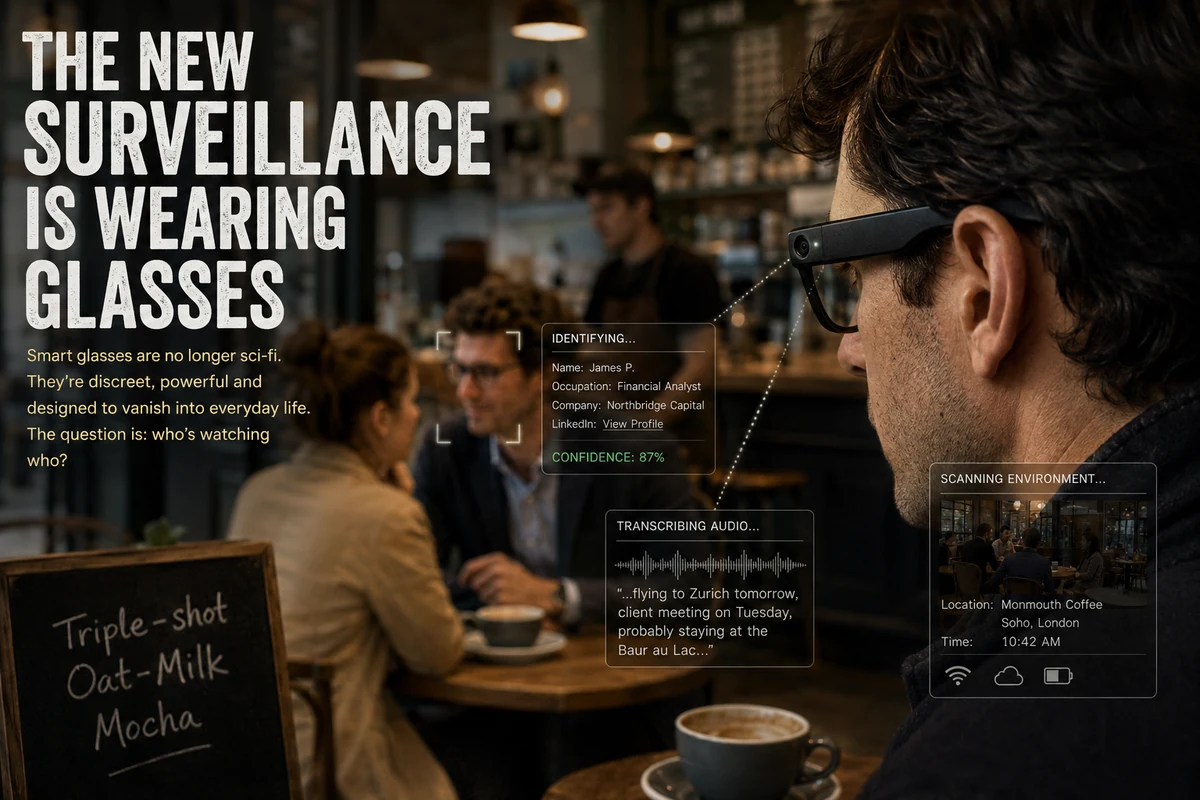
"They look expensive. They look fashionable. They are, almost certainly, watching."
The Clever Thing Was Making It Disappear
The clever thing about smart glasses is not the technology itself. We already had cameras. We already had microphones. We already had facial recognition software, social media stalking and enough artificial intelligence to ensure that nobody under the age of twenty can now write a paragraph without consulting a robot first.
No, the clever thing was making the technology disappear. That was the hurdle.
Human beings are remarkably tolerant of surveillance provided it arrives looking expensive and slightly fashionable. CCTV cameras make us uneasy because they resemble prison architecture. A man openly filming strangers with his mobile phone appears suspicious because civilisation has not yet entirely collapsed. But spectacles? Spectacles suggest harmlessness. At worst, they suggest an optician.
And so we arrive at the modern smart glass: outwardly indistinguishable from ordinary designer eyewear, but internally capable of recording video, capturing audio, responding to voice commands and, increasingly, interpreting the world through artificial intelligence in real time.
Not Cameras. Wearable Intelligence Systems.
The important distinction is that these devices are no longer simply cameras you wear on your face. They are becoming wearable intelligence systems. Which sounds convenient right up until the point one remembers that intelligence systems are not morally selective. They are equally useful to tourists, journalists, bored teenagers, private investigators and psychopaths.
Manufacturers insist upon safeguards. Some models include tiny recording lights intended to warn nearby people that filming is taking place. This would perhaps be reassuring if humanity did not possess a long and glorious history of immediately bypassing every safeguard ever invented. Within months, hobbyists and online tinkerers were already demonstrating methods of obscuring or disabling the indicators entirely. The modern consumer no longer merely buys technology; he immediately searches the internet for ways to make it less ethical.
The Social Problem Nobody Planned For
This creates an entirely new social problem. For most of modern history, surveillance required effort. Somebody had to point a camera at you. There was choreography involved. You noticed the movement. There was at least the possibility of glaring disapproval. Smart glasses remove all of that. The person recording you can now appear to be doing absolutely nothing at all beyond listening politely and perhaps wondering whether the pastry selection justifies the queue.
When AI Meets Constant Observation
The genuinely unsettling aspect, however, is not the covert recording. We crossed that bridge years ago somewhere between smartphones and doorbell cameras. The real concern is what happens when artificial intelligence is connected to constant observation.
A pair of smart glasses connected to cloud-based AI can potentially identify faces, transcribe conversations, recognise locations, interpret logos, remember names and quietly assemble fragments of personal information from entirely ordinary interactions. Separately, each fragment appears harmless. Together, they form the sort of profile that once required a private detective in a raincoat and questionable hat.
A determined fraudster no longer needs to “hack” you in the Hollywood sense. He merely needs context. Where you work. Where you travel. Which hotel chain you prefer. Whether you seem lonely, affluent, distracted or flattered by attention. Human beings leak astonishing amounts of information simply by existing in public, and modern AI systems are becoming exceptionally good at collecting the drips.
The Real Threat Is Depressingly Mundane
The great misconception about surveillance technology is that people imagine dramatic espionage scenarios involving secret agents and encrypted briefcases. In reality, most exploitation is depressingly mundane. Romance scams. Confidence tricks. Phishing emails tailored with just enough personal detail to appear convincing. The future criminal mastermind may not resemble Blofeld so much as a persistent man in fashionable eyewear asking entirely reasonable questions near an airport lounge.
Naturally, some claims about smart glasses drift into science fiction. Despite the panic, we are not yet living in a cyberpunk dystopia where strangers instantly access your banking records merely by looking at you across Pret A Manger. Most facial recognition systems still rely heavily on publicly available information, linked accounts, social media carelessness and cloud processing. The technology is impressive, but not magical.
Unfortunately, human beings have become so catastrophically indiscreet online that “not magical” is often more than sufficient.
What You Can Actually Do About It
The sensible response is not paranoia. It is awareness.
People should begin treating smart glasses the same way they treat smartphones: assume they may be recording. Avoid displaying unnecessary personal information in public. Conference badges, boarding passes, visible work lanyards and even carelessly overheard conversations provide useful intelligence to anybody inclined to misuse it. We have spent two decades being told not to publish our lives online while simultaneously volunteering them to strangers in coffee shops.
The Problem for Businesses
Businesses, meanwhile, are likely to face awkward conversations very soon. It is one thing to ban phones from sensitive meetings. It is quite another to ban spectacles from somebody’s face without appearing to audition for the role of paranoid dictator in a Cold War thriller. Yet sectors dealing with confidential information — finance, law, defence, healthcare — will eventually have little choice but to confront the issue.
Privacy Is Becoming Invisible
The broader truth is that privacy itself is becoming invisible. Surveillance used to be obvious. Cameras were mounted on walls. Microphones sat on tables. Recording devices looked like recording devices. Now they resemble jewellery, watches, doorbells and prescription eyewear. The technology is dissolving into everyday life until observation itself becomes ambient.
Which is perhaps the final irony.
For years, technology companies promised us a “frictionless future”. What they neglected to mention was that friction was often the only thing protecting us. The awkwardness of taking out a camera. The social discomfort of openly recording strangers. The visible signs that observation was taking place.
Remove the friction and surveillance stops feeling exceptional. It simply becomes part of the atmosphere. Like weather. Or advertising. Or low-level existential despair.