
A Sprawling Taxonomy of Human Optimism
There are moments in life that arrive unannounced and leave you questioning not merely your afternoon, but the entire trajectory of Western civilisation. Sunday’s car boot sale was one of them.
I had ventured out with the modest ambition of acquiring groceries. What I found instead was a sprawling taxonomy of human optimism laid out on trestle tables — clothing that had clearly given up, vinyl records by artists whose continued existence in any format represents a philosophical challenge to the concept of quality control, and, presiding over it all with the quiet menace of a fever dream, an array of secondhand technology that would have given even the most credulous of early adopters cause for reflection.
Among the more archaeologically interesting exhibits were several cordless analogue phones — those beige-and-grey monuments to a period when the revolutionary act of wandering twelve feet from the kitchen wall with a telephone handset was considered a lifestyle upgrade. These devices operate on frequencies so comprehensively unencrypted that a mildly curious neighbour with the right equipment could, in principle, listen to your side of any conversation with the attentiveness of a trained therapist, though presumably with less restraint about sharing what they hear. The fact that they were on sale at all suggests their previous owners had reached the same conclusion and acted accordingly. The fact that someone had priced them for resale suggests a rather touching faith in the possibility of a second life.
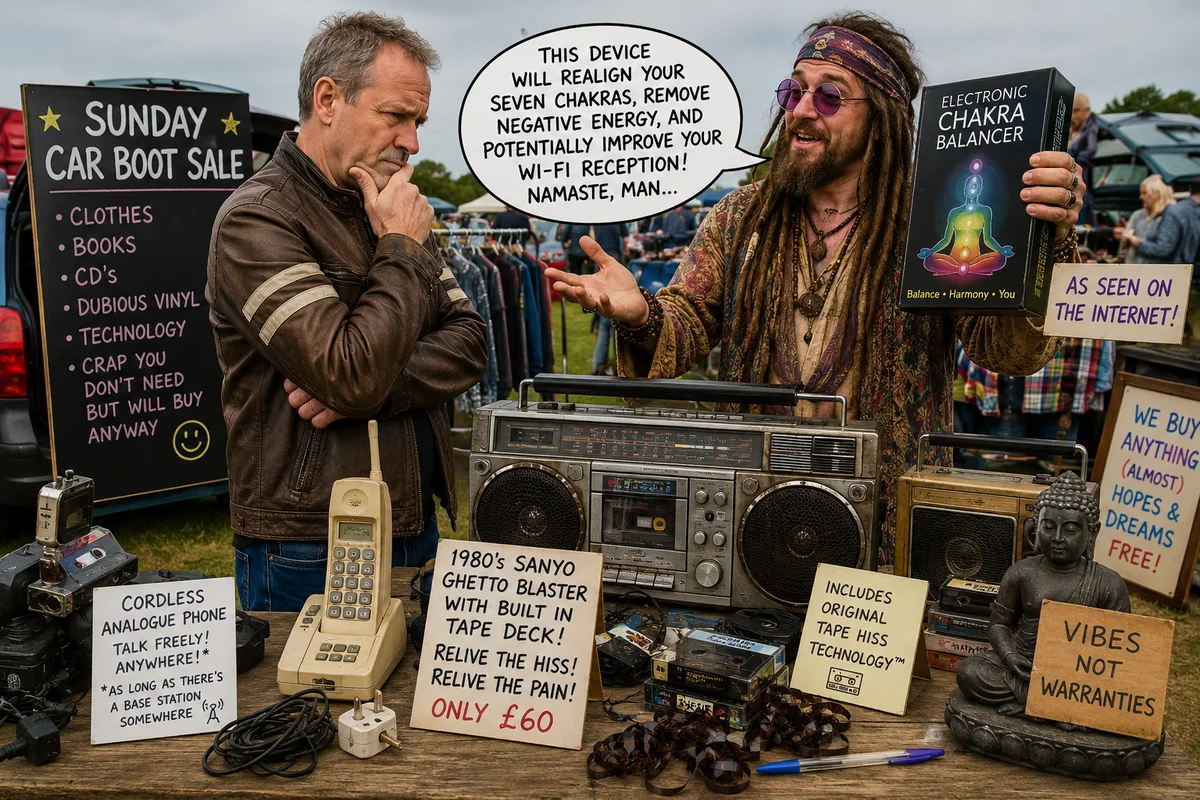
“Balance • Harmony • You — As Seen on the Internet.”
The Chakra Balancer: A Masterwork of Ambitious Nonsense
The piece that stopped me in my tracks — and I say this as a man not easily stopped — was an electronic chakra balancer. The box made claims of such magnificent ambition that I briefly wondered whether I had stumbled onto the set of a documentary about the limits of human credulity. The stallholder, who presented himself as what you might charitably describe as a New Age hippie assembled from discontinued parts, launched immediately into a sales patter lifted wholesale, one suspected, from something called "The Woo-Woo Handbook for Dummies". He informed me, with the serene confidence of a man who has never been seriously questioned, that the device would render my seven chakras in a state of perfect balance.
I listened with the polite attention one extends to a man who believes he is making sense. Then I explained that, following a serious motorcycle accident some fifteen years prior, emergency surgery had necessitated the removal of one of my chakras, and that consequently his device, however sophisticated, would be operating at something of a deficit. He received this information with an expression suggesting the universe had not prepared him for it.
The Sanyo Ghetto Blaster: A Monument to Obsolescence
Nearby sat an outrageously overpriced 1980s Sanyo ghetto blaster — a monument to an era when portable audio equipment was designed primarily for intimidating pedestrians.
It offered FM radio, a medium now so comprehensively colonised by the BBC’s benevolent certainty about what the public deserves to hear that one approaches it less as entertainment and more as a test of civic endurance. The Corporation has long maintained a uniquely proprietary relationship with the concept of public taste, curating it with the quiet authority of an institution that has never seriously entertained the possibility of being wrong, and the FM dial in 2026 reflects this editorial confidence with a thoroughness that leaves little room for dissent.
But the machine’s true glory resided in its tape deck, that magnificent engine of disappointment, which in its heyday gave you first the warm, companionable hiss of a pre-CD recording — a sound that audiophiles of the period had not yet learned to find embarrassing — and then, at a moment of its own choosing, the quiet horror of mechanical digestion. Your carefully compiled mixtape would be drawn slowly inward, mangled beyond recognition, and returned to you only after a forensic operation involving a Bic biro, considerable patience, and the kind of language that would have disappointed your mother. Hours of careful coaxing, the cassette spools turning millimetre by millimetre, the tape emerging in the particular condition of something that has survived an industrial incident. The Bic biro, for those who were there, was not a writing implement in these moments. It was a surgical instrument.
The Verdict
The lesson, I think, is this: technology acquired from a car boot sale should be approached with precisely the caution one applies to the local pub on match day — which is to say, not at all, and certainly not without someone nearby who knows where the exits are.
The car boot sale serves a genuine social function, of course. It is one of the last remaining venues where the full archaeology of domestic life can be surveyed for a modest entry fee, where the optimism of previous decades sits in the open air awaiting reappraisal, and where a man in a bandana will attempt, with complete sincerity, to improve your energy field using mains electricity. One should be grateful for the experience. One should simply not, under any circumstances, be grateful enough to buy anything with a plug on it.