
A Proposition Too Reasonable to Refuse
There exists in the human heart a cavity of quite extraordinary dimensions, shaped precisely to accommodate the possibility that somewhere, recently, science has quietly solved the bit of fitness that requires actual effort. This cavity is not a character flaw. It is a design feature — the cognitive equivalent of a USB port, waiting patiently for the correct device to be inserted. The wellness industry has spent several decades and an amount of money that would make a small government blush attempting to manufacture that device, and has produced, in the process, a bewildering catalogue of belts, patches, creams, vibrating platforms, and electrical appliances whose relationship to genuine physiology is roughly equivalent to the relationship between a ouija board and structural engineering.
Into this tradition steps the electronic ab pad: a device of serene ambition, which proposes that the musculature of the human abdomen can be persuaded into a state of attractive orderliness by the simple application of low-level electrical current while its owner sits in a chair doing something unrelated. The proposition, stated plainly, is this: connect yourself to mains electricity, continue your afternoon, and emerge, in the fullness of time, transformed. It is, one must admit, an offer of considerable appeal. I accepted it. This is the account of what followed.
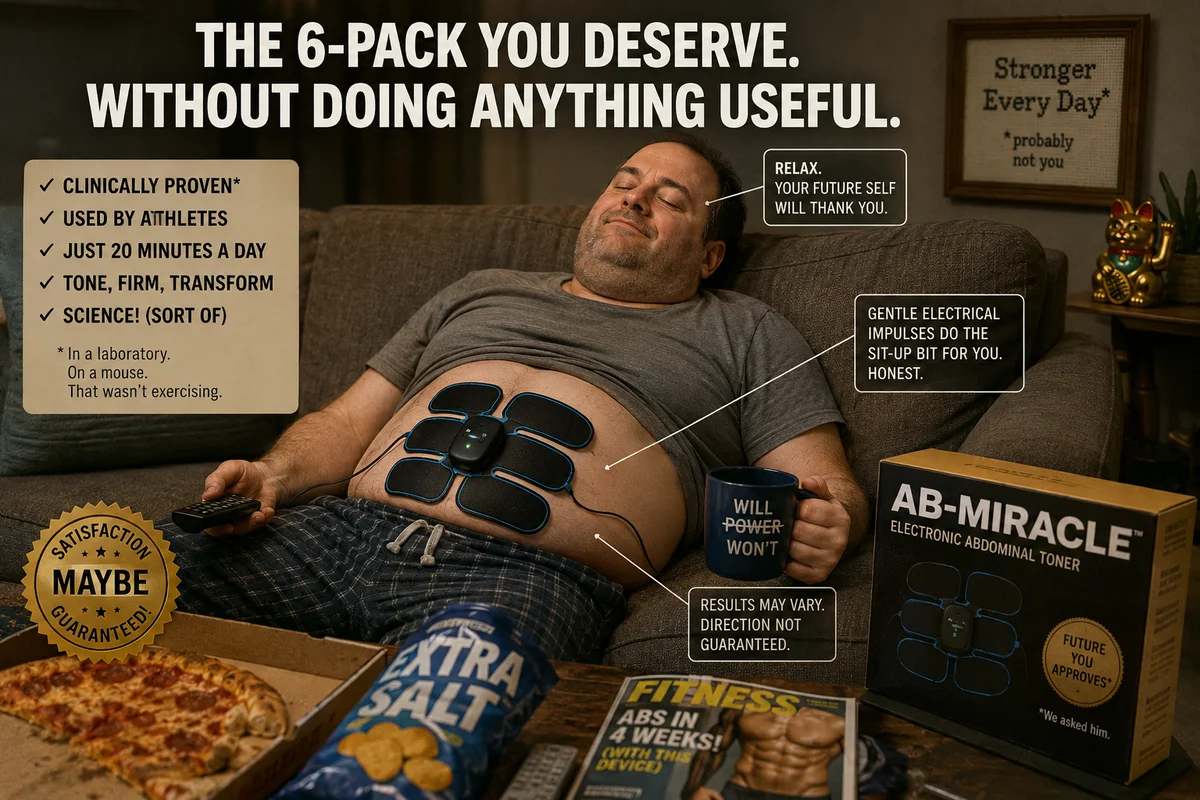
“Clinically Proven • Used By Athletes • Results May Vary Dramatically.”
The Experiment, and Its Findings
Let the record show that I was not idle during the experimental period. Alongside the electronic intervention, I was maintaining a daily caloric intake of under fourteen hundred calories — a regime that requires the sustained willpower of a Victorian prison warden applied to one’s own appetite, and that had, in fact, produced measurable results in every other region of the body. The shoulders retreated. The face acquired new angles. Trousers that had once issued quiet structural protests began to hang with something approaching contentment. The trajectory was, by any scientific measure, encouraging.
The belly, however, had other ideas.
While the rest of me participated in the general programme of reduction with what one can only describe as cooperative enthusiasm, the belly moved in the opposite direction with the quiet confidence of a man who has read the contract and found a clause nobody else noticed. It grew. Not dramatically, not in the manner of a special effect, but with a steady, purposeful expansion that made the overall picture considerably more confusing than the box had implied it would be.
A Theory, Advanced with Appropriate Caution
I offer the following hypothesis not as established science but as the kind of reasonable supposition that presents itself when the alternative is concluding that one’s own body has simply decided to be difficult. The electronic pads, it is possible, were working. Not in the direction advertised, but working nonetheless. The muscles of the abdomen, subjected to repeated electrical stimulation, may have been quietly growing in competence and dimension — growing, specifically, outward — pushing the whole arrangement forward from the inside with the enthusiasm of a renovation project that has dramatically exceeded its original brief. The belly was not getting fatter. It was getting a structural upgrade that had not been requested and could not, from the outside, be distinguished from getting fatter.
This is, when one thinks about it, the kind of plot twist that could only have been written by a universe with an extremely well-developed sense of irony and no particular obligation to be helpful. The device worked. The result was worse. The improvement was real. The mirror disagreed. These statements are not contradictory. They are simply the wellness industry, operating as designed.
The Resolution, Which Arrived by Doing Nothing
Since stopping the electronic pads, the belly has flattened.
I invite the reader to sit with that sentence for a moment, because it contains a philosophical knot of some density. The intervention caused the problem. The removal of the intervention solved the problem. The product therefore both failed completely and succeeded magnificently — depending entirely on which end of the timeline one is standing at, and which direction one is facing. The manufacturer could, in strict technical terms, claim vindication. They have chosen not to, presumably because “stops working to achieve results” presents certain challenges for the marketing department.
And here we arrive at the distinction that the wellness industry has spent decades attempting to obscure: the difference between a civilised ambition and an aspirational one. I did not want a six-pack. I wish to be absolutely clear on this point, because the industry is deeply invested in persuading everyone that the six-pack is the only legitimate destination, and that any lesser goal represents a failure of commitment rather than a triumph of proportion. A flat stomach is a civilised ambition. Modest. Reasonable. The ambition of a man who simply wants his shirt to hang correctly. And he got there. By doing nothing.
On the Six-Pack, and Its Fundamental Misunderstanding of the Assignment
The six-pack, by contrast, is a body so comprehensively depleted of everything comfortable that the underlying scaffolding has become visible — like a building with the cladding removed. Nobody looks at exposed scaffolding and calls it an improvement. One notes the absence of the cladding. One wonders, briefly, about the project management. One moves on. And yet there is an entire industry devoted to the achievement of this effect on the human torso, requiring years of early mornings, protein shakes that taste like chalk dissolved in mild despair, and a permanently brittle relationship with bread that no sensible person should be asked to sustain.
The transaction does not, on inspection, hold up. For most people, looking slim is the win. Looking healthy is the win. Looking like someone who has a relaxed and functional relationship with their own body is, it turns out, the win that the audience actually scores. I know this because I recently observed, in the wild, a man who had clearly made all the sacrifices. Shirtless. Outdoors. Adorned with a six-pack of such geometric precision that it appeared to have been applied by a draftsman rather than developed by a human being. A monument to discipline and privation, a walking advertisement for the concept of effort, presented to the world at maximum possible exposure.
The women in the immediate vicinity ignored him with a thoroughness that suggested not malice but simply the reallocation of attention toward things they found more interesting, which appeared to include everything else. The market had spoken, and it had said: put your shirt back on, have a biscuit, and rejoin the conversation. You will be considerably better company, and the biscuit was innocent all along.
The Verdict
The electronic ab pad sits in a drawer now. Not in disgrace — it is difficult to hold a piece of consumer electronics in contempt when it has, however accidentally, produced the desired outcome by a route nobody considered — but in the particular retirement of a tool whose job, it turned out, was to teach its user that the job did not require the tool. This is not nothing. As lessons go, it cost considerably less than a gym membership and required substantially less lycra.
The shirt hangs correctly. The calorie deficit continues its quiet, unglamorous, entirely effective work. And somewhere out there, the man with the geometric six-pack is presumably still standing in the sun, waiting for someone to notice, consoled only by the knowledge that he has done everything right and the universe has, once again, declined to care.
One wishes him well. And a biscuit.