An Uncomfortable Sentence
Science is the process we use to try to better understand the world we live in. It is not a religion, nor is it a philosophy. It is a method — observation, hypothesis, experimentation, testing, criticism and refinement — refined over centuries, and it has given us an extraordinary ability to understand and predict the world around us.
And yet, increasingly, I hear people declare: “We are the science.”
I find that sentence almost the polar opposite of what science actually is. Science is not an authority to be obeyed. It is a process built to challenge authority — including its own.
What Science Actually Is
You begin with an observation or a question, and you formulate a hypothesis. You test it. You refine it. You attempt, deliberately, to prove yourself wrong. You document what you find and put it before others, so they can scrutinise the evidence, reproduce the experiment, and try to find the flaw in your conclusion. An idea earns scientific credibility not because someone in authority declares it true, but because it survives repeated, genuine attempts to knock it down.
Even then, it remains provisional. A theory can be extraordinarily well supported without being treated as immutable truth — and the history of science shows exactly why that humility matters. Some of the most successful ideas of one generation have gone on to be refined, expanded, or replaced entirely when new evidence arrived.
Consider Newton. His laws of motion and universal gravitation were an enormous leap, and for centuries they were the dominant framework for understanding how the universe moves. Then Einstein's theories of relativity changed our understanding of space, time and gravity at a deeper level still. Newton was not simply proven wrong. Newtonian physics turned out to be an exceptionally accurate approximation within the conditions we normally experience — and Einstein provided the deeper framework that explained what Newton's model could not reach. That is refinement, not failure. It is, if anything, the system working exactly as intended.
When Authority Was Wrong
History also offers no shortage of examples where an idea was rejected, ridiculed, or actively suppressed — sometimes by the very institutions considered the authority of their day.
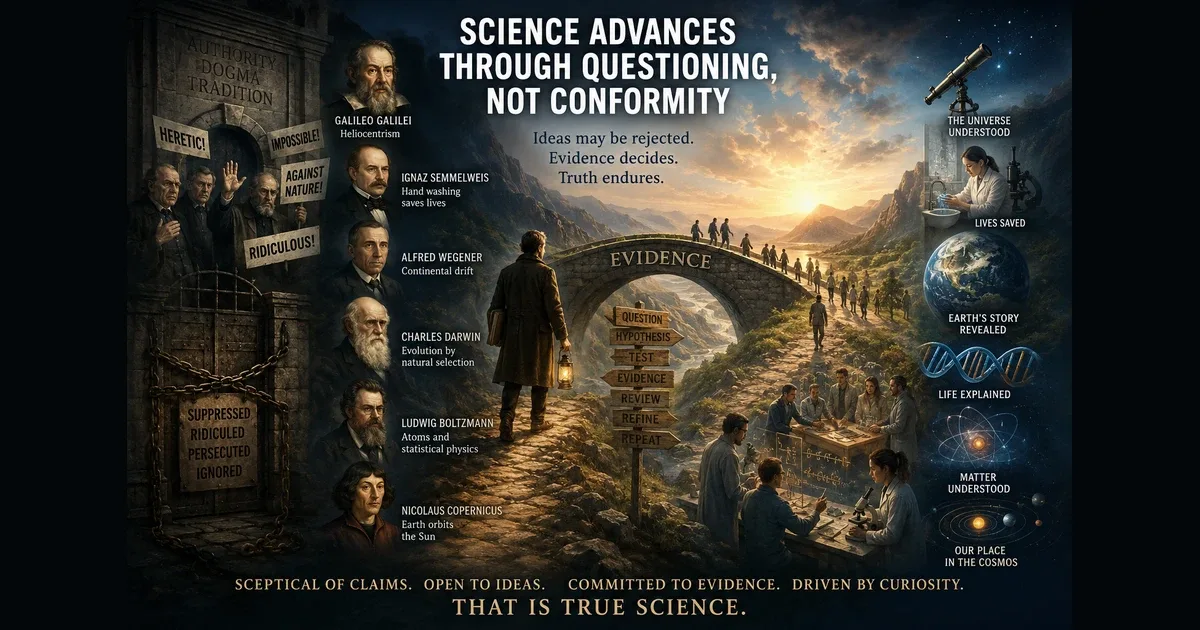
Galileo is the most familiar case. His advocacy of heliocentrism — the idea that the Earth moves around the Sun — brought him into conflict with the Roman Catholic Church. In 1633 he was tried by the Inquisition, forced to recant, and spent the remainder of his life under house arrest. The lesson here is not simply that he was eventually proven right. It is that an institution holding authority over accepted knowledge was fully capable of suppressing an idea that threatened its worldview.
Ignaz Semmelweis, a nineteenth-century Hungarian physician, noticed that doctors moving directly from dissecting corpses to examining women in maternity wards were associated with dramatically higher rates of fatal fever. He proposed that handwashing in a chlorine solution would greatly reduce deaths. The medical establishment met the idea with resistance and ridicule, and his career deteriorated as a result. Today, hand hygiene is one of the most fundamental principles of infection control. Semmelweis had identified something true decades before germ theory existed to explain why.
Alfred Wegener proposed in 1912 that the continents had once been joined and had since drifted apart. Geologists largely mocked the idea, not least because he couldn't offer a convincing mechanism for how a continent might actually move. He died in 1930 without seeing it accepted. Decades later, seafloor spreading and paleomagnetism supplied the missing mechanism, and continental drift became the modern theory of plate tectonics.
Copernicus, Darwin, and Ludwig Boltzmann — whose work on atoms faced serious opposition at a time when some prominent scientists doubted atoms were physically real at all — belong on the same list. The history of science is littered with ideas that seemed absurd, impossible, or simply uncomfortable at the time, and some of them went on to transform our understanding of reality entirely.
The Trap Waiting on the Other Side
There is an important distinction here, and it cuts the other way.
The fact that an idea is rejected by the establishment does not make it correct. For every Galileo, Wegener, or Semmelweis, there are countless people whose supposedly revolutionary ideas were simply wrong. Being an outsider is not evidence of being right. Being ridiculed is not evidence of being right. And calling something a “conspiracy theory” doesn't automatically make it wrong, any more than calling something “established science” automatically makes it right.
The lesson from history is not that we should believe every unconventional claim. The lesson is that unconventional claims should be judged by evidence, not by the status of the person making them.
A distinction worth holding onto Terms like “pseudo-science” can be perfectly legitimate descriptions — there really are bad methodologies, unfalsifiable claims, and ideas unsupported by credible evidence. But when a label becomes a substitute for actually examining the argument, it stops serving science and becomes a rhetorical weapon instead.
What True Scepticism Actually Requires
True science should have nothing to fear from questions. It should have nothing to fear from scepticism. It should have nothing to fear from somebody asking, “what if we're wrong?” That question is not an attack on the process. It is the process.
If an established theory is correct, it should survive scrutiny. If a new hypothesis is wrong, testing should expose its weaknesses. And if an established understanding really is incomplete, the people willing to challenge it may eventually be the ones who move it forward.
Scientific progress asks for two things that can look contradictory: rigorous scepticism, and intellectual openness. We should be sceptical of extraordinary claims — and just as sceptical of our own certainty.
The Question We Should Never Fear
Sometimes the person proposing the seemingly ridiculous idea really is wrong. But occasionally, they aren't. And when they aren't, the willingness to actually investigate that idea — rather than dismiss it on the strength of who's asking — is the difference between preserving what we think we know and discovering something we didn't.