
A Noble Endeavour, Reluctantly Undertaken
Recently I have, in a fit of what one might generously call self-preservation, embarked upon a health kick. The sort of enterprise usually announced with solemn confidence and abandoned somewhere between the first quinoa and the second packet of biscuits. Low carb, high protein, reduced enthusiasm for anything that tastes remotely like joy — the usual modern pilgrimage.
In the course of this noble endeavour, I have been reading the pronouncements of various online medical sages, who speak of visceral fat in tones normally reserved for approaching comets or inconvenient prophecies. It appears this particular fat — not content with merely existing in plain sight — prefers to nestle around your internal organs like an unwelcome tenant with no intention of leaving.
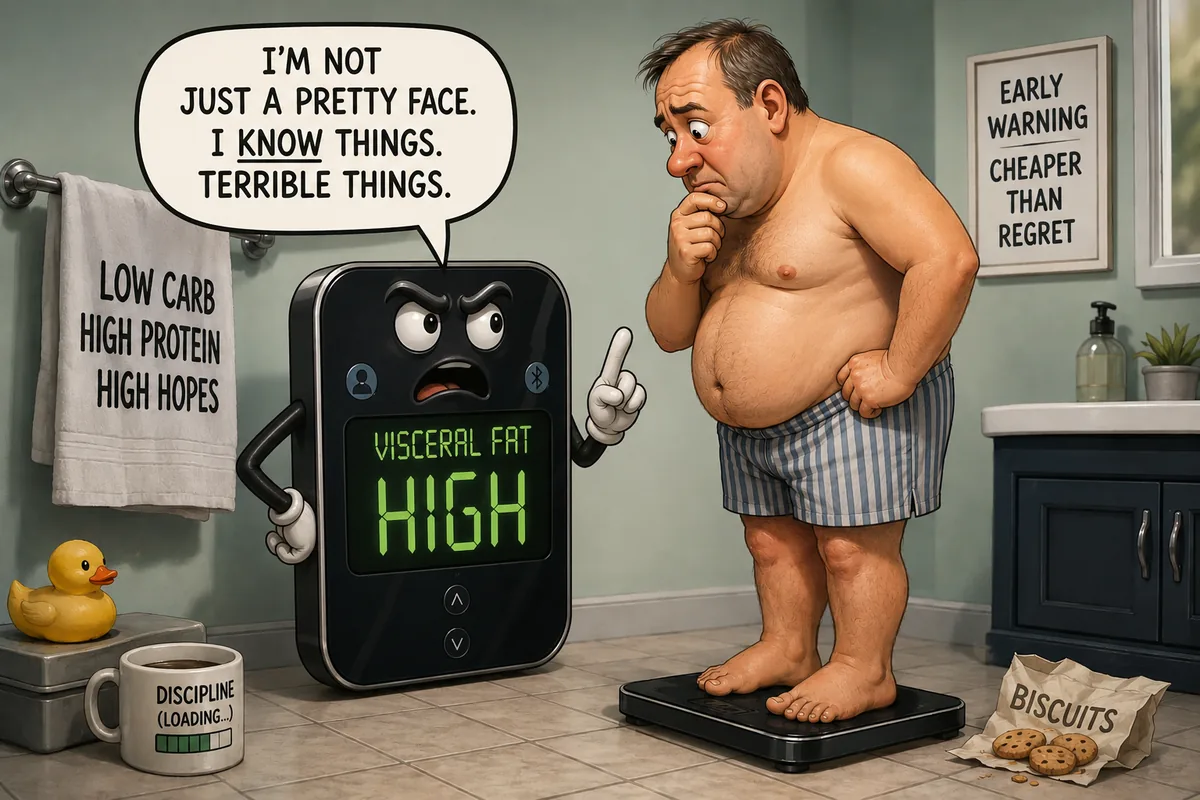
"I'm not just a pretty face. I know things. Terrible things."
The Consequences, They Assure Us, Are Not Trivial
The online medical establishment would like you to know that high visceral fat is associated with a rather unpleasant roster of consequences:
- Increased risk of heart disease
- Hypertension — high blood pressure, for those who prefer their doom in plain English
- Insulin resistance, potentially leading to type 2 diabetes
All of which tends to give one the distinct impression that the human body is less a temple and more a poorly managed rental property.
The GP Appointment Problem
The standard advice, of course, is to consult your GP for proper testing. Which is sensible in the way that flossing is sensible: universally acknowledged, frequently postponed, and oddly difficult to fit between work, life, and the minor administrative chaos of merely existing in the 21st century.
Which raises the obvious question: if modern life won't allow us the luxury of timely medical diligence, is there at least a shortcut that doesn't involve rearranging one's entire calendar and possibly one's will?
Enter the Domestic Oracle
Enter the so-called smart scale — a sort of domestic oracle that promises early warnings for the price of a takeaway pizza's more self-righteous cousin. These devices can be found for as little as £10 from the world's favourite online purveyor of everything, from toothbrushes to existential regret.
How It Works: Bioelectrical Impedance Analysis
The smart scale estimates visceral fat using something called bioelectrical impedance analysis, or BIA for short. This involves sending a harmless low-level electrical current through your body and measuring the resistance encountered along the way. Different tissues — fat, muscle, bone, and presumably the faint residue of last Christmas — all respond differently, allowing the device to make its estimations.
In other words: you stand on it barefoot in the morning, and it silently judges you using the principles of physics you last encountered in school and immediately betrayed.
It is worth noting that consumer BIA scales are not clinical instruments. They are approximations — useful for spotting trends and broad indicators rather than delivering the sort of precision your consultant would stake their reputation on. Results can be affected by hydration levels, recent meals, and the general caprice of the universe. Used consistently, however, they provide something genuinely valuable: a direction of travel.
The Supposed Benefits of Knowing
The importance of monitoring visceral fat, the medical community reminds us, lies in early detection. High levels are associated with the same familiar suspects:
- Increased risk of heart disease
- Hypertension
- Insulin resistance leading to type 2 diabetes
And early detection, in turn, is meant to prompt decisive action:
- Adjusting diet — generally interpreted as “less nice things”
- Increasing physical activity — generally interpreted as “more sweating”
- Consulting a healthcare professional for proper evaluation — generally interpreted as “admitting defeat in a more structured environment”
The Modern Compromise
In conclusion, the smart scale does not so much solve the problem of visceral fat as it solves the more modern task of alerting you to its presence with admirable punctuality. It is, in essence, a tiny domestic prophet: inexpensive, mildly accusatory, and powered by the same electrical principles that ensure your toaster remains suspiciously optimistic about bread.
And so we arrive at the modern compromise — between knowledge and convenience, between medical caution and the brutal honesty of a £10 device that tells you, before breakfast, that your internal organs may be living in interesting times.
It will not replace your GP. It is not trying to. But as a nudge, a prompt, a quiet and slightly judgmental presence in the corner of the bathroom — it earns its place.