
The World’s Most Successful Distraction Machine
The smartphone has become mankind’s most successful portable distraction machine. Millions now spend their evenings performing the solemn democratic duty of approving photographs of strangers’ lunches or denouncing celebrities they had not heard of the previous afternoon. The device once advertised as a miracle of communication has instead become a pocket-sized voting machine for trivialities.
Yet the principle itself is not entirely foolish.
People have become remarkably accustomed to expressing opinions through a screen. They vote on comments, rank services, review taxis, approve videos, condemn films and settle arguments about footballers with the tap of a thumb. The technology already exists for large populations to register approval or disapproval instantly. The curious thing is not that this happens constantly, but that it is almost never used for anything of consequence.
One begins to wonder whether the smartphone might accidentally become the tool that changes democracy more than any speech or manifesto ever did.
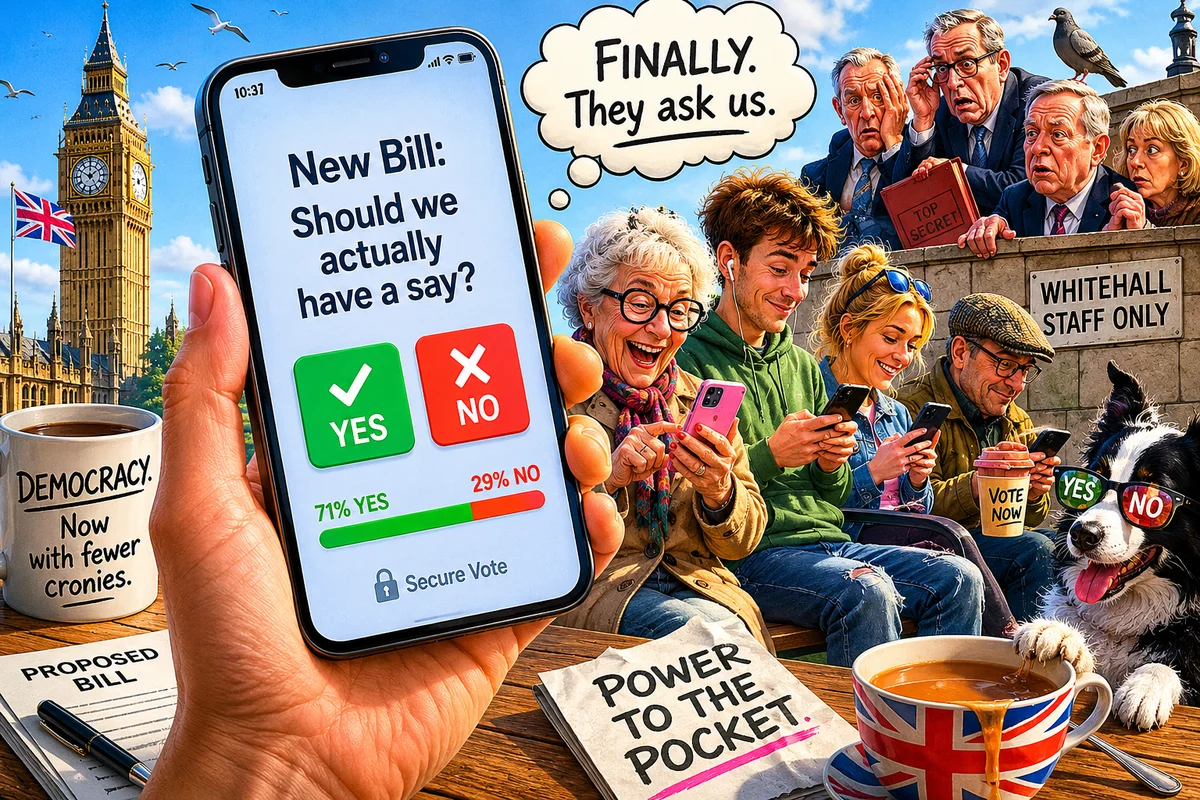
“Democracy. Now with fewer cronies.”
A Modest Proposal for the Legislative App Store
A government could, in theory, publish proposed laws directly to the public through a secure national application. Citizens would receive a short explanation of the bill in plain English, followed by the opportunity to vote for or against it directly from their phones. Instead of waiting years to express approval or irritation at the ballot box, the public could participate continuously in the legislative process itself.
The advantages are obvious enough. Public opinion would no longer need to be interpreted second-hand by parties, advisers and career operators whose principal skill often appears to be surviving committee meetings. Laws could reflect the immediate will of the electorate rather than the calculations of parliamentary management. Expensive layers of administration might shrink considerably once politicians discovered that millions of people were perfectly capable of pressing buttons without supervision from Whitehall.
The Objections, and Why They Are Mostly Technical
Naturally, the arrangement would require safeguards. Identity would need to be verified securely, voting systems protected properly, and legislation explained clearly enough that the average citizen need not possess a law degree to understand what is being proposed. None of these problems are especially exotic. Banks already trust people to move their life savings through a telephone while sitting in traffic outside Guildford.
The larger objection is philosophical rather than technical. Representative democracy was designed partly because direct democracy was impractical in nations of millions. Gathering the population together in the market square becomes difficult once the market square contains seventy million people and just one branch of Greggs. Smartphones alter that equation entirely. For the first time in history, it is possible for an entire nation to participate in decision-making instantly from the comfort of the sofa.
The Wisdom of Crowds, Before and After Breakfast
Whether this would produce wiser government is another question altogether. The public is capable of moments of great wisdom and moments of astonishing idiocy, often before breakfast. Still, it is becoming increasingly difficult to argue that ordinary people are uniquely unqualified to make decisions while simultaneously insisting they are qualified to choose the people who make them.
The faces peering over the Whitehall wall in the photograph above — clutching their Top Secret files with the expression of men who have just discovered that the locks have been changed and the building let out to the public — understand this perfectly well. The system as currently constituted depends rather heavily on the electorate being consulted infrequently, briefly, and under conditions of maximum ambiguity. A smartphone in every pocket changes the arithmetic in ways that several careers in public administration were never designed to survive.
The border collie, meanwhile, has already made up its mind. One notes that it voted both ways simultaneously, which is arguably more honest than most parliamentary divisions on record.