
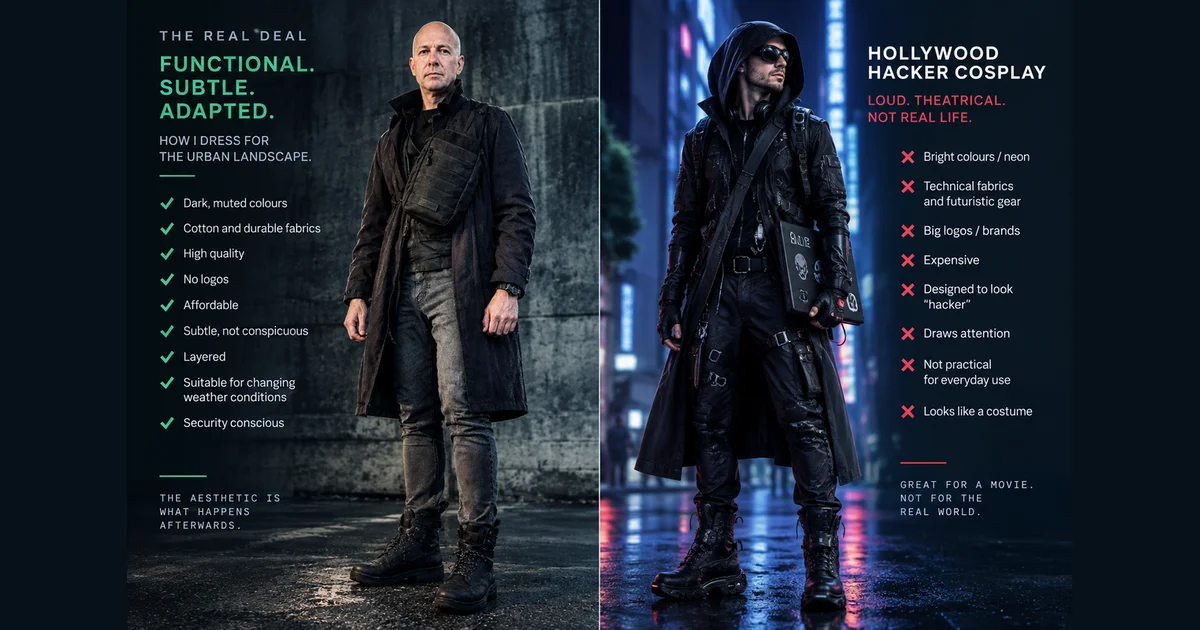
Equipment, Not Fashion
Clothing is another form of equipment. It needs to work, survive regular use, accommodate changing weather and, preferably, not cost a fortune. Looking reasonably good is useful, but it isn't the primary objective.
The aesthetic is largely an unintended consequence.
My requirements are fairly simple:
- Dark, muted colour palette
- Cotton where practical
- Durable construction
- Good quality
- No prominent logos
- Affordable
- Subtle rather than conspicuous
- Layered
- Adaptable to changing weather
- Security conscious
None of these requirements particularly screams cyberpunk or post-apocalyptic. Put them together, however, and things get interesting.
Heavy black cotton. Worn grey denim. Substantial boots. A dark overcoat. Functional bags. Subtle asymmetry. Robust watches.
The result has a certain aesthetic. I didn't particularly set out to create it.
Why Not Ex-Military?
The obvious temptation when looking for durable, functional clothing is surplus military equipment. There is plenty of good stuff available. It's generally designed to be abused, repaired and used in unpleasant conditions, and from a purely functional perspective there's a lot to like.
But there is a problem. It looks like military clothing.
Camouflage is particularly unsuitable for an urban environment, unless your objective is to attract attention by looking like you've recently escaped from a military exercise. Soldiers generally don't wear their uniforms when off duty, for a reason.
The point of clothing in an urban environment isn't to make you look equipped. It's to blend into the environment while quietly being equipped. So I tend to borrow the principles of military clothing rather than the appearance:
- Durability
- Practicality
- Layering
- Weather resistance
- Useful pockets
Just without the camouflage.
The Comic-Con Problem
There is another trap. Once you start deliberately pursuing a particular aesthetic, it's surprisingly easy to go too far. Add enough tactical clothing, straps, pouches, technical fabrics and military hardware, and you eventually stop looking like somebody going about their business and start looking like somebody who has travelled to a convention specifically to explain their loadout. That's not the objective.
The same applies to cyberpunk. A little influence can be interesting. Too much and you're effectively wearing a costume. I'm interested in the suggestion of a style rather than the declaration of one.
And No, I Don’t Dress Like Lisbeth Salander
At least, I hope not.
The Swedish film version of Lisbeth Salander has a very specific visual identity. It works for the character because she's young, distinctive, and deliberately outside conventional society.
I'm approaching fifty.
There comes a point where you have to accept that clothing has to work with the person wearing it. Ripped skinny jeans that might have looked appropriate twenty years ago aren't suddenly made sensible because somebody has added black boots and a leather jacket. Age, stature, proportions and context matter.
The objective isn't to dress like a younger version of yourself. It's to take the underlying principles that appeal to you and translate them into something appropriate for who you are now. That's considerably more difficult. It's also considerably more interesting.
Buy the Garment, Not the Label
One of the advantages of this approach is that it doesn't require expensive clothing. In fact, expensive clothing can sometimes make the process harder. I'm looking for things that:
- Fit properly
- Are well made
- Have useful construction
- Don't advertise the manufacturer
- Cost an amount I'm comfortable paying
A charity-shop overcoat can work. A heavily constructed cotton jacket can work. A pair of durable boots can work. The label doesn't matter. If something is inexpensive, well made and fits properly, that's a successful acquisition. The trick is learning to recognise potential rather than branding.
The Resulting Uniform
There isn't really a uniform. There is simply a collection of decisions that have become consistent over time.
Dark colours make things easy to combine. Layers make changing temperatures manageable. Durable fabrics tolerate regular use. Muted clothing doesn't attract unnecessary attention. Functional bags carry what's needed without looking like equipment. And good boots solve several problems simultaneously.
The result happens to look slightly post-apocalyptic. Add a restrained amount of cyberpunk influence, and perhaps a little old-school hacker aesthetic, and it becomes recognisable as my style. But none of those things are the objective.
The objective is clothing that works.
The aesthetic is what happens afterwards.